Country Lifestyle
June 2017 Profile: Wayne Cornish
(Courtesy of Wayne Cornish)
Son of Mr. Rodeo
By Laci Jones
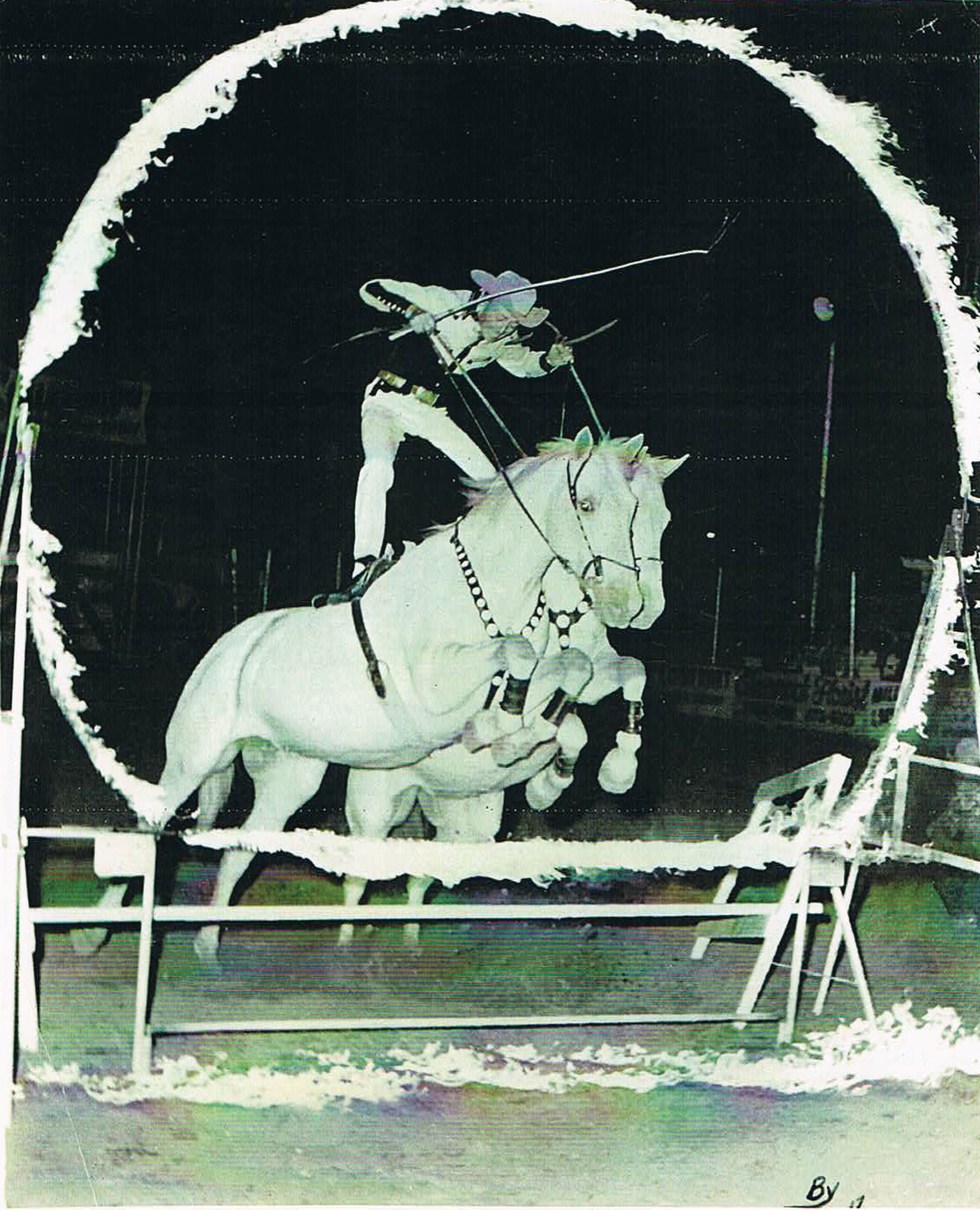
Eighty-two-year-old Wayne Cornish walked through his home in Enid, Okla., that is filled with old memorabilia and talked as if the photos were taken yesterday. He pointed to a large black and white photo of two men jumping over a fence while standing atop two Roman riding teams. The two men in the photo happen to be Cornish and his father, Cecil Cornish.
“I’m going to tell you a story,” Cornish began.
A man came to their farm near Waukomis, Okla., requesting to take a picture of the father-son duo. Cecil told the photographer, “We are going to have to get them ready, but I guess we will get a picture.” They took their Roman riding teams—Cornish’s “The Flying White Clouds” and Cecil’s “The Golden Eagles” to the pasture and the picture was taken.
“It was the first and only time they jumped together,” said Jackie Cornish, Wayne Cornish’s wife of 22 years.
Formerly known as Mr. Rodeo among his friends, Cecil was born in 1909 in Waukomis, Okla. He began his rodeo performance career in the 1930s. As an animal lover, he began training a six-month-old colt named Smokey to perform tricks, later becoming one of his favorite acts. The pioneer performer taught Smokey how to dance, shake hands and play dead, among other entertaining tricks.
While he initially took to the rodeo circuit competing as a bronc rider and roper, he later began performing. Arguably, his most famous acts included Smokey, his Brahma bull named Danger, six Palomino liberty horses and his Roman riding team. Throughout his career, there were three Danger bulls, which he taught to jump over a car as well as other tricks.
Throughout his career, Cecil performed with other legends including Gene Autry, Roy Rogers, Red Ryder and Little Beaver. He was a member of the Cowboys Turtle Association, the predecessor of the Rodeo Cowboys Association, later becoming the Professional Rodeo Cowboys Association.
He performed across the United States and Canada including Madison Square Garden in New York and the Cow Palace in San Francisco. The pioneer performer once estimated he performed in more than 800 rodeos, according to an article written by Randy Witte in the December 2000 issue of “Western Horseman.”
In the prime of his performance career, Cecil and Juanita were married in 1933. With Juanita making his fancy show attire, the couple often traveled together for performances. His outfits were as memorable as they were colorful and elaborate, according to his biography in the ProRodeo Hall of Fame.
Two years after Cecil and Juanita were married, their only child was born in Waukomis, Okla., on Feb. 2. Following in his father’s footsteps, Cornish began performing at a young age. His rodeo debut was at the age of five when barrel men John Lindsay and Hoyt Heifner put Cornish on a calf in Ponca City, Okla.
“I rode him plum across the arena,” Cornish said with a laugh. “I remember my boots fell off, but I rode that bull.”
The bullfighters laughed about the performance and gave the young bull rider $4 for his rodeo debut. During this time, Cornish also performed in Cecil’s act where Danger would jump over a car.
“I would lay down in the back seat, the bull would jump over us and I would crawl out and act like I had been sleeping,” Cornish laughed.
The Cornish family traveled from coast to coast together throughout his childhood. In fact, he spent more time on the road with his parents than in school. The family was at a rodeo across the United States when Juanita said Cornish needed to get back to school. Cecil said the experience would not hurt the young performer, but Juanita insisted.
“They got Wayne back to school, but Cecil wasn’t happy about driving all the way back here and all the way back to the rodeo,” Jackie explained.
Cornish was later expelled from school because of his absences, after working a rodeo in east Texas. Cecil visited the school board to get Cornish back in school.
“Cecil said, ‘He probably learned more from going to the rodeo than he would’ve in school,’” Jackie added.
The school allowed the student to return to school, but he continued to travel the rodeo circuit. The rodeo clown got his Rodeo Cowboys Association Card in 1953 and graduated from high school a year later.
It wasn’t long before commentators referred to Cornish as “a chip off the old block who is rapidly becoming a block of his own.” Like his father, many of Cornish’s acts included animals—six golden liberty horses, a pig Cornish referred to as a garbage disposal and The Flying White Clouds.
He started working with The Flying White Clouds in 1953, performing many tricks which included jumping through rings of fire. Cornish said his dad helped him train Susie and Sallie, sisters in The Flying White Clouds, but Ed Curtis helped the performer at an event in Kansas. He said they had a light show and one of the horses fell over backwards during the jump, throwing Cornish. Curtis helped get the horses under control, he added.
“To this day, they always jump perfectly,” Cornish beamed. “They were a perfect, perfect act and they were never hurt again.”
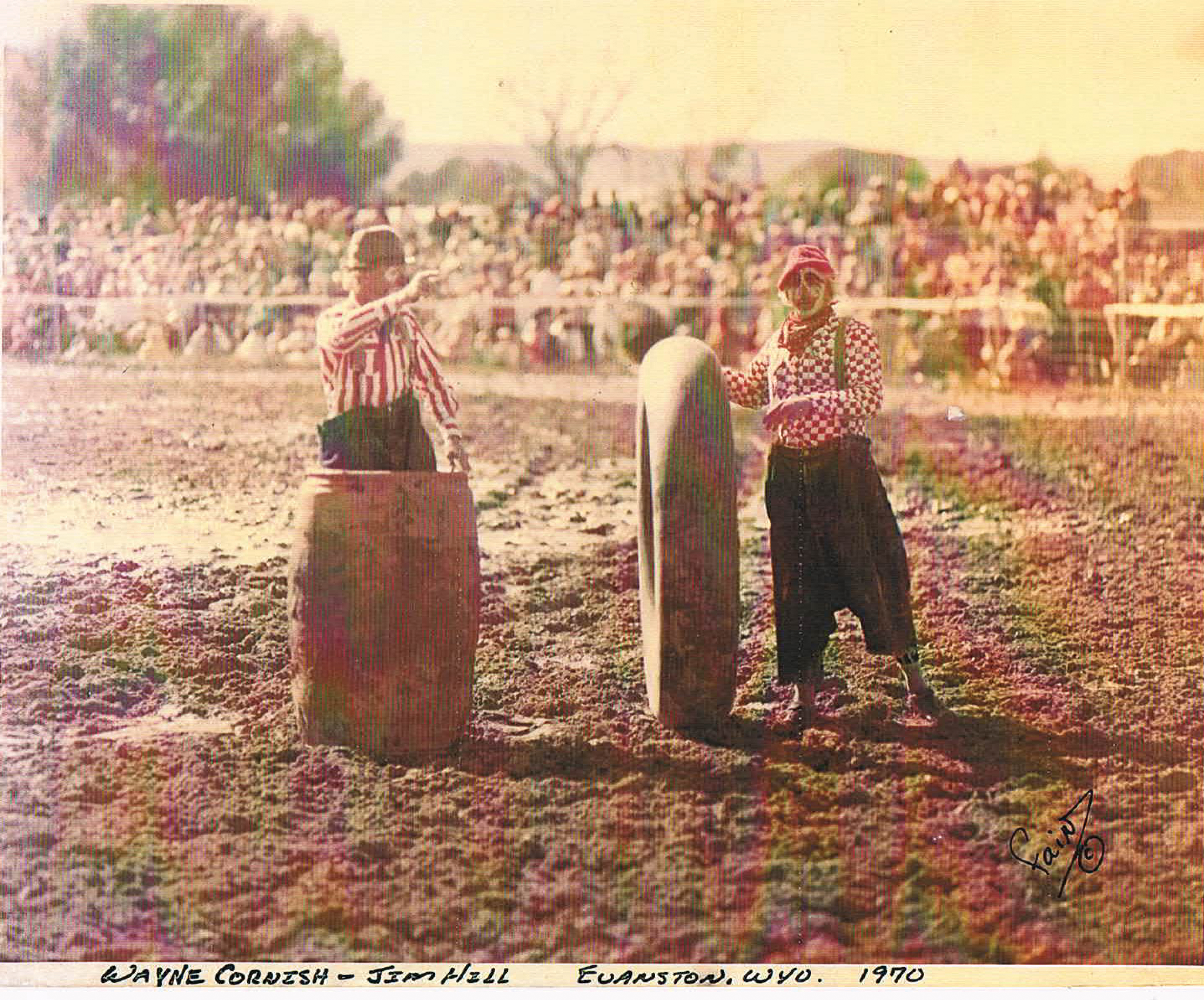
While he continued his specialty acts, Cornish preferred clowning and being a barrel man. Cornish has more than 20 years of stories while wearing the clown suit and painted face.
“We didn’t know we was rodeoing,” Cornish explained. “We worked hard.”
He performed with some of the best rodeo clowns including Oklahoma natives Dixie Mosley, Junior Meek and Jim Hill, describing them as “some of the best in the world.” Performing was not always work as many of the rodeo clowns enjoyed pulling practical pranks on one another.
It once snowed the night before a scheduled rodeo in Utah, and Cornish said there were maybe three or four people in the stands watching the rodeo. He came out with his old suit on because he did not want to get muddy for only a few people.
“[Jim Hill] moved over behind me and shoved me down in the mud, but I got him,” he recalled. “He said, ‘We need a picture,’ so I hit him. He was a funny act.”
Cornish once performed in front of then-President Harry S. Truman at a rodeo in his hometown of Independence, M.O. Margaret Truman accidentally stepped on her dog’s tail, making the dog yelp.
The yelp sounded like the nickname for former president, Dwight Eisenhower, “Ike.” Cornish told the former First Lady that he would have to shoot the dog for yelping “Ike, Ike, Ike.” The rodeo clown said President Truman just laughed.
Cornish worked as a rodeo clown in many of the rodeos his father performed in, and they often traveled together from coast to coast. Together, they worked in large rodeos as well as the small, local rodeos.
Being a rodeo clown and performer does not come without risks. Like many rodeo cowboys, Cornish suffered from many injuries including broken ribs to broken shoulders. A broken neck in 1962 prevented him from working in the National Finals Rodeo in Oklahoma City.
The injuries he sustained throughout his career was one of the reasons Cornish put away his clown outfit. Another reason for quitting was because of Cecil. By 1971, Cornish said the animals were getting older, which lead Cecil to decide on retiring after returning from a rodeo in Evanston, Wyo.
“He said, ‘Son, I want to tell you something. Smokey is getting a lot of miles on him, and I had pretty good luck for all them years that he had,’” Cornish recalled. “Some people really thought they were a good act and they were.”
While he no longer performed as a rodeo clown or performer, Cornish remained invested in the rodeo circuit by hauling horses. Traveling across the United States and Canada, he hauled horses for Ashland, Neb., Hull and Smith; Walter Merrick, race horse breeder from Sayre, Okla.; and Betty and Dee Raper, Belle Mere Farm in Norman, Okla. Cornish said he was always on the road, and he once got a call from Raper who was checking in on him.
“He said, ‘Wayne, are you all right?’” Cornish recalled. “I said, ‘Yes sir, I’m working and busy. I got things to do.’”
Jackie said the Rapers said they have never had anyone before or since Cornish who was as responsible. He hauled racing horses and roping horses. Among those horses included Genuine Risk, one of three fillies that won the Kentucky Derby.
“I hauled a lot of horses—good horses from Florida to California,” Cornish added.
Cornish said he later started hauling livestock but quit because of his daughters. When asked if he missed being on the road, he said “I do” without hesitating.
Since then, he has attended many rodeo clown reunions. One reunion was held at Oklahoma City. Donning his clown suit, he and nine other rodeo clowns raced donkeys and mules in Remington Park. Cornish laughed and said he wanted to prove to the other clowns that he could win the first mule race held at Remington Park, and Cornish succeeded. He was awarded a belt buckle for the achievement.
Among his many achievements includes a lifetime member of the PRCA. The former rodeo clown has received the Andy Womack Memorial Award, named after a rodeo clown from the ‘30s to ‘40s. The memorial award is the highest award a rodeo clown can receive.
In 1991, Cecil was inducted into the National Cowboy Hall of Fame, and was inducted into the ProRodeo Hall of Fame in 2003. He died later that year in Enid, Okla.
The Cornishes collected many years’ worth of rodeo memorabilia. In 2010, a storm caused them to pack the memorabilia including photos belt buckles, medallions and other irreplaceable items into a large suitcase and other bags.
They took the items to Jackie’s mother’s storm shelter to keep them safe. They did not tell anyone where they put the memorabilia, but Jackie was apprehensive about leaving the precious items. She suggested putting a padlock on the storm shelter, but Cornish and her mother believed the items were safe.
“We go over to get [the memorabilia] and this one big suit case that would’ve taken two people to get it out of there is gone,” Jackie recalled. “We searched everywhere, and I know nobody would have just taken them and thrown them away.”
The irreplaceable items have yet to be returned. Some memorabilia, including the barrel Cornish used in his rodeo clown days, is on display at the National Cowboy and Western Heritage Museum in Oklahoma City.
Two years later in August, Cornish had a brain aneurysm. When they arrived at the hospital, the neurosurgeon showed Jackie a picture showing the blood clot in Cornish’s cranium and told her he was likely going to die. The neurosurgeon presented the option of surgery, but the chances of the former rodeo performer surviving were minimal.
“I went up to the chapel and said a lot of prayers,” Jackie recalled. “I said, ‘If he can’t be himself, then take him, but if he can, leave him here because I need him.’”
Cornish survived the surgery and was taken to the intensive care unit. While many still believed Cornish would not survive, Jackie knew he would. The aneurysm affected his central nervous system on the left side, impacting his vision and speech, she added. Five years later, Jackie supports Cornish by serving as his eyes and helping tell many stories of his career in the rodeo circuit.
“There’s not much I can do without her,” Cornish added.
Cornish and Jackie met when they were teenagers and were high school sweethearts. Their families were good friends, but Jackie’s parents thought Cornish was too old to date her.
“I always liked her,” he explained. “I really did like her.”
They went on to marry other people, but they were reunited 30 years later. The couple married in 1995. The couple has six daughters from previous marriages: Donna Kay, Shawna, Jacquetta, Kelly Ann, Kimberly and Karen.
“I am so blessed that he is still here,” Jackie said and she laughed. “He is just so funny.”
While the Cornishes only attend a few local rodeos each year, Cornish enjoys making people laugh and reminiscing on the days when he wore the clown suit.
This article originally appeared in the June 2017 issue of Oklahoma Farm & Ranch.
(Courtesy of Wayne Cornish)
Save