Country Lifestyle
November 2017 Profile: Scott Landgraf
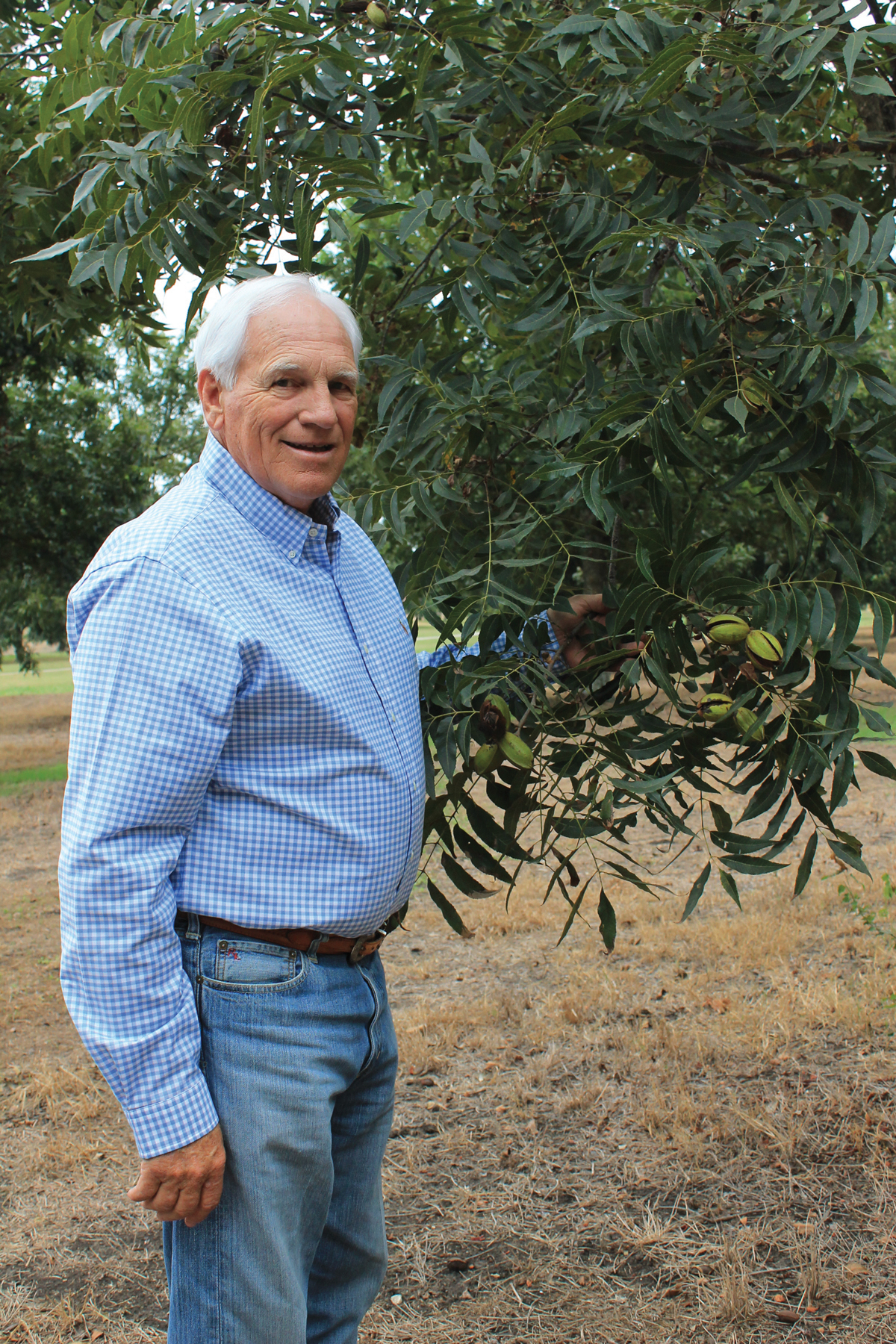
Scott Landgraf pictured with a pecan tree behind his house in Madill, Okla. (Photo by Laci Jones)
Our Vision. Our Pecans.
By Laci Jones
On a cloudy, late September morning in Madill, Okla., Scott Landgraf picked a pecan off the ground and pulled out a small pocket knife. The owner of Landgraf Farms began carving away the shell, leaving two pecan halves. Once he finished splitting the pecan, he looked up and said, “This is a lost art.”
Oklahoma produces an average of 20 million pecans each year, Landgraf explained. This year, Oklahoma is predicted to harvest 30 million pounds of pecans.
“The largest crop that’s been reported in history is 60 million from Oklahoma,” he added. “I don’t know how this crop is going to come out, but it may be more than 30 million this year. It’s really a pretty good crop.”
Born in 1948, Landgraf saw firsthand the advancements in pecan harvesting, sanitization and shipping. Growing up, his father Bill Landgraf harvested native pecan trees that grew along the creeks.
“My interest in pecans stemmed from the first real money I ever made by picking pecans up out of the water in the creek,” Landgraf recalled. “It was very hard work, but I look back on it as favorable memories.”
The father-son duo climbed many native pecan trees and used cane poles to flail the pecans. The pecans that landed on the bank were his dad’s, and Landgraf claimed the pecans that he could clean out of the creek, he added.
“My family saw pecans as an opportunistic crop,” Landgraf said of his parents. “It was not a crop per se. It was just something that enabled them to have extra things for what we think as today as just bare necessities.”
In the early to mid- ‘60s, Bill began seeing pecans as orchards. He cleared bottomland and started grafting the pecan trees to varieties available—Stuart and Mahan. Bill later began experimenting with different pecan varieties in the ‘70s. While some pecan varieties fared better than others, Bill had a successful harvest. His wife Leota took the first step in marketing Landgraf Farms by selling pecans out of their carport.
Meanwhile, Scott Landgraf attended Murray State College in Tishomingo, Okla., where he met his wife Janice. A year behind Landgraf in college, she followed the Madill, Okla., native to Oklahoma State University, where she received a bachelor’s degree in education. They married in 1971.
While pursuing a master’s degree in agronomy from OSU, Landgraf began working for the Noble Foundation. Landgraf obtained his master’s degree in 1973 and began his career spanning 30 years with the foundation now known as the Noble Research Institute. Landgraf first worked as a manager of their soil and forage testing laboratory. As time progressed, the manager became an agricultural consultant.
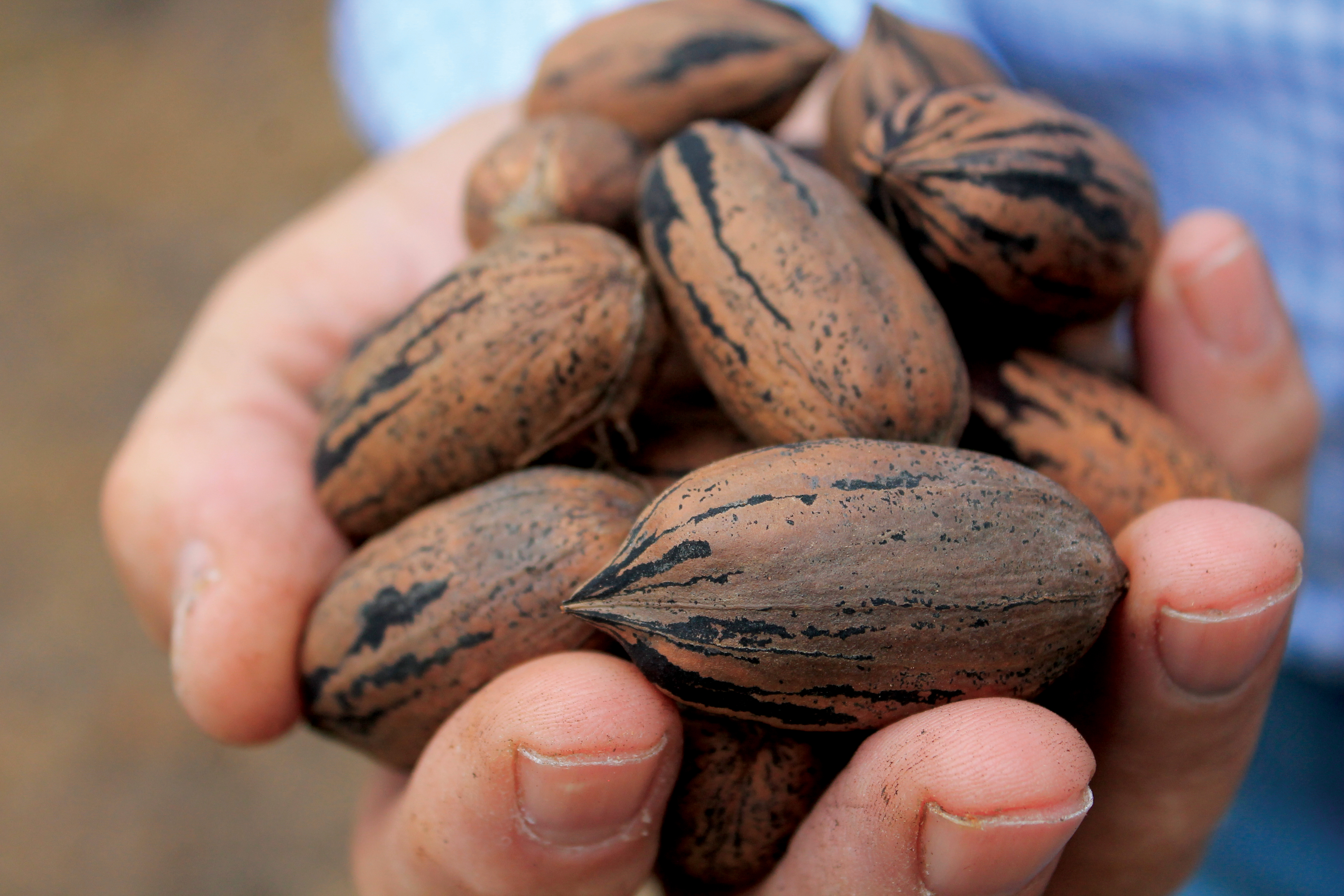
Landgraf Farms plant a variety of pecans on their farm in Madill, Okla., including the Pawnee variety. (Photo by Laci Jones)
“As time went on, they recognized my interest in pecans,” Landgraf explained. “I continued to do a lot of work in water and nutrition associated with pecan production and towards the end of my tenure with the Noble Foundation, I was their pecan specialist. My years at Noble have provided me an amazing education into the process of growing pecans.”
At 55 years old, the pecan specialist retired from the Noble Foundation to focus on the family farm. He started his pecan orchard in 1976, planting 250 pecan trees out of sight.
“I planted them back where nobody could see them because I didn’t know if it was going to work or not,” Landgraf laughed. “I was afraid of everyone seeing my failure.”
The planting was successful with only about three trees dying that season. Landgraf said the first season proved the pecan business takes labor and commitment. From planting to harvest, pecan production became a family endeavor.
“In fact, we had a baby at the time, and we set a playpen in the middle of planting trees,” Landgraf recalled. “We basically planted trees around the baby.”
That commitment was tested in June 1996 when a thunderstorm uprooted nearly every native pecan tree to the east of the farm. While orchards were also located on the west side of the farm, Landgraf said the storm demolished one of their main sources of income and involvement in pecans.
“It was a matter of just pushing them up in a pile and burning them,” he added. “There was no recovery.”
The setback resulted in a family meeting to discuss the future of Landgraf Farms.
“I remember very vividly setting the family around the table to say, “Hey, are we going to go ahead and rebuild this or are we going to just stay at this size?” he recalled.
It was a unanimous decision among the Landgraf family to rebuild the orchard. They cleaned up all the debris from the storm, drilled wells and installed irrigation lines. With a large tree spade, they moved half of the trees on the west side of the farm to the east.
Many people commented on the project, thinking the Landgraf’s were building a large barn.
“When I got ready to transplant the trees, I cut all side limbs off and painted the trunks white,” Landgraf explained. “When they looked up here, it did look like the start of a barn with just a pole sticking up.”
The project could be viewed from the Landgraf’s back window. His wife Janice said the trees looked like a cemetery with the trees resembling tombstones. She asked Landgraf if it will ever look like a pecan orchard, he recalled with a laugh.
Today, the pecan orchard no longer looks like a cemetery but like a pecan orchard, but each year takes the same commitment and hard labor as the first year. Each January and February, the Landgrafs plant 10 to 15 acres of new orchards, which entails installing main water lines, irrigation systems and well development.
Buds start to break by the first of April, and Landgraf applies zinc and nitrogen to the developing leaves.
“I might put on an insecticide, but I think that the zinc and nitrogen spray is just really important to the development and the health of the tree,” he added.
During the dormant season, he monitors for common diseases and pests that can be detrimental to the health and development of the pecan trees including pecan scab and pecan nut case bearer.
The shucks on the pecans start to split by the end of September. Because the pecans are not harvested until October and November, the pecans are vulnerable to freeze.
“There’s still that existing threat,” Landgraf explained. “As soon as the shuck splits, the shucks start to dry down and the nut is physiologically mature, we’ll start harvest.”
Landgraf harvests 160 acres on the farm, 100 acres on his father’s leased land and 500 acres of native pecan trees on leased land. He also currently has almost 100 acres of pecan trees planted that are not in production. The Landgrafs plant different varieties of pecans including Kanza, Caddo, Choctaw and Pawnee.
The Choctaw variety is their No. 1 big nut, Landgraf said. The desirables are big nuts, but they are disease-prone. Producers who choose to plant the Choctaw variety need to increase their “level of management” because the Choctaw variety requires plenty of water and nutrients to resist these diseases, he added.
The Kanza variety is a high quality pecan, but it is a small nut. The Caddo variety is similar to the Kanza variety in size, but it is more susceptible to diseases like scab. It is a high-quality nut and the most consistent yielder.
Landgraf found consumers will not purchase the small pecan varieties like Kanza and Caddo in the shell because it is smaller than other varieties. However, consumers prefer the smaller nuts that are high-quality when the shells are removed.
“In all of agriculture, I think we have to conform our production practices to meet the demand of the consumer,” Landgraf explained. “In our retail shop, we certainly abide by that rule and cater to them.”
The Pawnee variety matures first, and the Landgrafs begin harvesting this variety by mid-October. The nuts are taken to the shop where they are cleaned, sanitized and dried.
“It is kind of an arrangement with my wife and me that I get them to the shop, and she takes them and sells them,” he added.
His wife Janice uses social media along with drive-by traffic to sell their entire crop in the farm’s retail shop. The retail shop is open November and December each year, selling a variety of products including chocolate covered pecans and pecan oil. As soon as all sales are completed, Landgraf begins fertilizing and cleaning up any brush left over from harvest.
With more than 30 years of experience in pecan production, Landgraf said there are three keys to have a successful pecan orchard—water, micro-organisms and nutrition. Making sure the pecan trees have an adequate supply of water is the most important key. Landgraf Farms implemented an irrigation system to combat the common Oklahoma drought.
“Along with that, I make sure that I’ve got adequate water supply and all my irrigation comes from wells,” he added. “I’ve been blessed with a major aquifer under the farm that I was not aware of. It’s just a real blessing.”
The second and third keys to encouraging healthy pecans are proper nutrition and micro-organisms. The Landgrafs apply pesticides to overcome threatening pests. It is imperative for producers to understand the life cycles of insects and diseases to properly manage the orchard.
“I only use pesticides when I have to have them,” he added. “I’m not saying I’m against use of pesticides. It’s just I use them sparingly, and my greatest friends are the beneficial insects and all the micro-life in the soil.”
Landgraf said technology made a positive impact on this growing industry.
“It went from using a cane pole to get them out of the tree to not knowing where you go to buy a cane pole,” he added. “It’s been in my lifetime, and we take it for granted.”
The pecan shelling plants had large structures with different devices when Landgraf was young. He said there was a divide in the industry from the growers, the shellers and the sellers. Landgraf’s father approached Basil Savage of Savage Equipment after attending a pecan shaker demonstration in Madill, Okla.
He convinced Savage to construct the first pecan shaker in his machine shop in Ardmore, Okla. Savage built and sold him that pecan shaker to use on the large native trees at the farm. The machine was not big enough to shake the trees well, so they had to shake them several times.
“I mean it was cool to use a tractor to get those nuts out instead of having to crawl around like a squirrel,” Landgraf recalled. “That process continued on. I can harvest the 160 acres on this place in less than a week with myself and a couple hands. It’s just phenomenal.”
As for the future of Landgraf Farms, he said he hopes to continue the vision of expansion with his family. He and his wife Janice have three sons—Jeff, Wes and Justin, and four granddaughters.
The retail shop is located at 18814 Highway 70, Madill, OK 73446. For addition information on Landgraf Farms, visit www.LandgrafFarms.com.
This article originally appeared in the November 2017 issue of Oklahoma Farm & Ranch.