Equine
History of the Horseshoe Part 1
By Laci Jones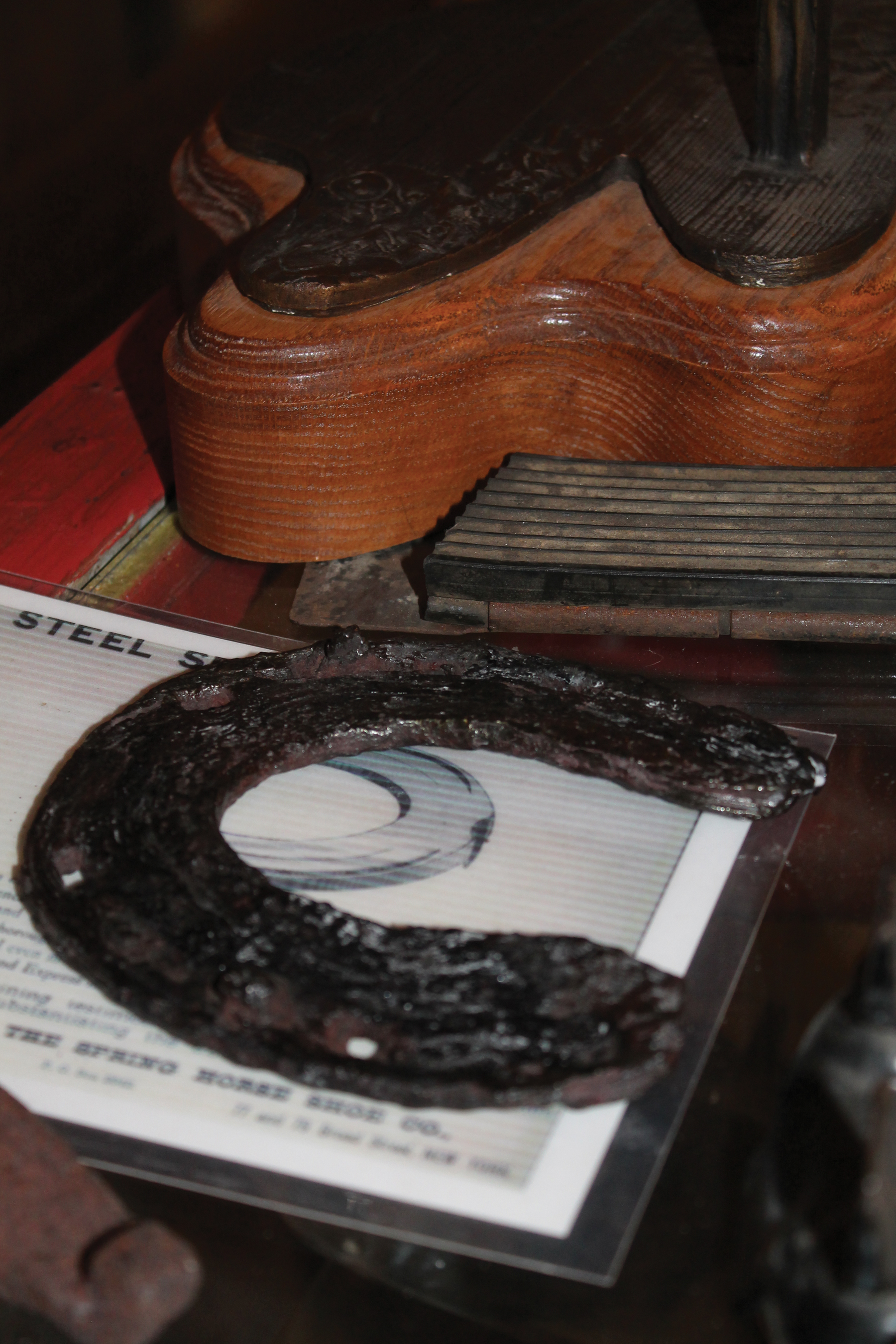
If it were not for the horseshoe and wagon wheel, the United States would not have been founded, according to Lee Liles. The owner of the National Museum of Horse Shoeing Tools and Hall of Honor said Oklahoma is the grandest example in the world.
Horseshoe books date back to 400 B.C. In fact, the oldest horseshoe at the museum in Sulphur, Okla., is more than 500 years old from Denmark.
“I don’t like going back much farther than 1860 because we don’t have the documentation to back it up,” Liles explained. “You got a few magazines like the Harper Weekly and the Wallaces’ Report, but you want to verify the facts.”
19th Century Patents
The first patent on a horseshoe manufacturing machine in the United States was issued in 1834 to Henry Burden, a Scottish-born industrial engineer. By 1850, Burden had more than 50 different patents on his machines at Burden Iron Works in Troy, N.Y., Liles added.
This was all before the first horseshoe nail patent, which was issued in 1863 to Daniel Dodge in Keeseville, N.Y. The horseshoe nail is the most difficult nail in history to manufacture, Liles explained.
“It’s got a lot of different tapers to it,” he explained. “The nail needs to be strong and durable enough to drive through a foot, come out, be turned over 180 degrees and clenched down in the horse’s foot.”
The nail industry has changed a lot throughout the years, Liles said. In 1853, the horseshoe nail was made from Swedish Iron, but copper nails have become popular in recent years. The oldest nail company left in the United States was the Capewell Horse Nail Company owned by the Mustad family. The nail company started in 1881, and they recently moved out of the country.
“All of these major shoe companies, tool companies and nail companies were located in the northeast United States,” he explained. “That’s where the population was. There weren’t any companies located down here in the South like Oklahoma or Texas.”
Horseshoeing Literature
Most information on horseshoeing actually came from Germany, Liles explained. German books were first written in 1861 by Leisring and Hardman. In 1882, Lungwitz was added as a co-writer.
“[Leisring, Hardman and Lungwitz] were the main vets at the Royal Veterinary College,” Liles said. “[Hardman] wrote his own first book in 1884 and wrote 24 editions. Nobody else has ever written that many books.”
Liles said books are the greatest assets for education. In 1866, the U.S. Congress adapted the cavalry books would be written on the Dunbar System.
“Alexander Dunbar was a person who our Federal Government paid to teach anatomy to horseshoers back in that era,” Liles explained.
John Kerman, who was running a horse shoeing school at Fort Carlisle, Penn., wrote the book written on the Dunbar System. The first American horseshoe book was written in 1871. In 1902, Kerman came to the shoeing school at Fort Riley, Kan.
“The cavalry has been the main source of horseshoers in this country up to the 1950s,” Liles said. “The Army technical manual, TM-220, has been the most copied horseshoeing book in history.”
In the 1890s, Pennsylvania State recruited Mississippi-native, John Adams as a professor. The university sent Adams to Germany to study under Lungwitz.
“When he came back in about 1896, he and Lungwitz were such good friends that he had permission to write the American edition of the Lungwitz book,” Liles explained. “When he came back, Adams brought an instructor from Germany to Penn State to teach anatomy and horseshoeing to the vet students.”
Even Cornell University and Michigan State University had a protégé of Lungwitz in 1913, Liles said.
William Russell
“We had a great educator in Cincinnati, Ohio, who wrote 15 horseshoeing books from 1879 to 1907,” Liles explained. “His name was William Russell.”
In 1887, the first shoemaking contest was held in Cincinnati, Ohio, where Russell won. “The contest consisted of making 100 shoes on an opry stage in front of 3,000 spectators,” Liles explained.
Russell made 100 horseshoes in two hours and 40 minutes with the help of a team. John Silk, who later became a famous horseshoer, was one of Russell’s competitors.
In the 1890s, many horseshoers, including Russell, created display cases filled with their horseshoes. Many of these display cases are still intact and hanging in the museum. One of the cases was in the World Fair in St. Louis in 1904.
“When it went to the World Fair, they added nails to the case,” he added. A photo of the case at the World Fair was added into one of Russell’s books, and it was one of the last display cases he made. Russell offered all of his collection for sale in the same year.
“He died in 1907,” Liles explained. “He was a sick man, and he was blind when he died.”
Aluminum Horseshoe
Liles also has a case located at the museum built in 1895 had an aluminum horseshoe inside. “That is very rare,” he said. “In that era, they only produced 65 pounds of aluminum per year. Aluminum was a precious metal, and you had to buy it through a jeweler.”
Liles said he does not think the aluminum held up well to wear and tear. William Wedekind received the title, “The World’s Greatest Horseshoer” at the 1892 Chicago World’s Fair. Wedekind even made an aluminum horseshoe in 1883.
“It was so light that it floated on water,” Liles explained. “They can’t duplicate the shoe today to make it float on the water.”
The Right Shoe
Liles said when people come to museum, they are used to dealing with one breed of horse and one discipline with the horse. The type of horseshoe used depends on the breed and the discipline. “In this country, we have roughly 400 different breeds of horses,” Liles said.
Liles said he was a horseshoer, which is a lot different from a cowboy shoer. For instance, a horse that is going to go trail riding or ranching needs a high-quality steel horseshoe.
A show horse will wear aluminum shoes because the aluminum will wear the toe quicker. “It will give him a quicker time to break that shoe in,” he added. “If your shoe isn’t new at the show, he has to get that shoe back to where it feels comfortable.”
Many of the plastic shoes are meant for horses that are on concrete, asphalt or wood. Liles said plastic shoes are commonly used in the circus.
A common misconception is people think the weight of the horseshoe affects a horse in either racing or working. “They think plastic is so much lighter,” he explained. “If that is the case, why don’t you just ride him barefoot?”
To learn more about the history of the horseshoe, visit www.horseshoeingmuseum.com.
This article was originally posted in the July 2016 issue of Oklahoma Farm & Ranch.
Save