Country Lifestyle
August 2017 Profile: Fred Rule
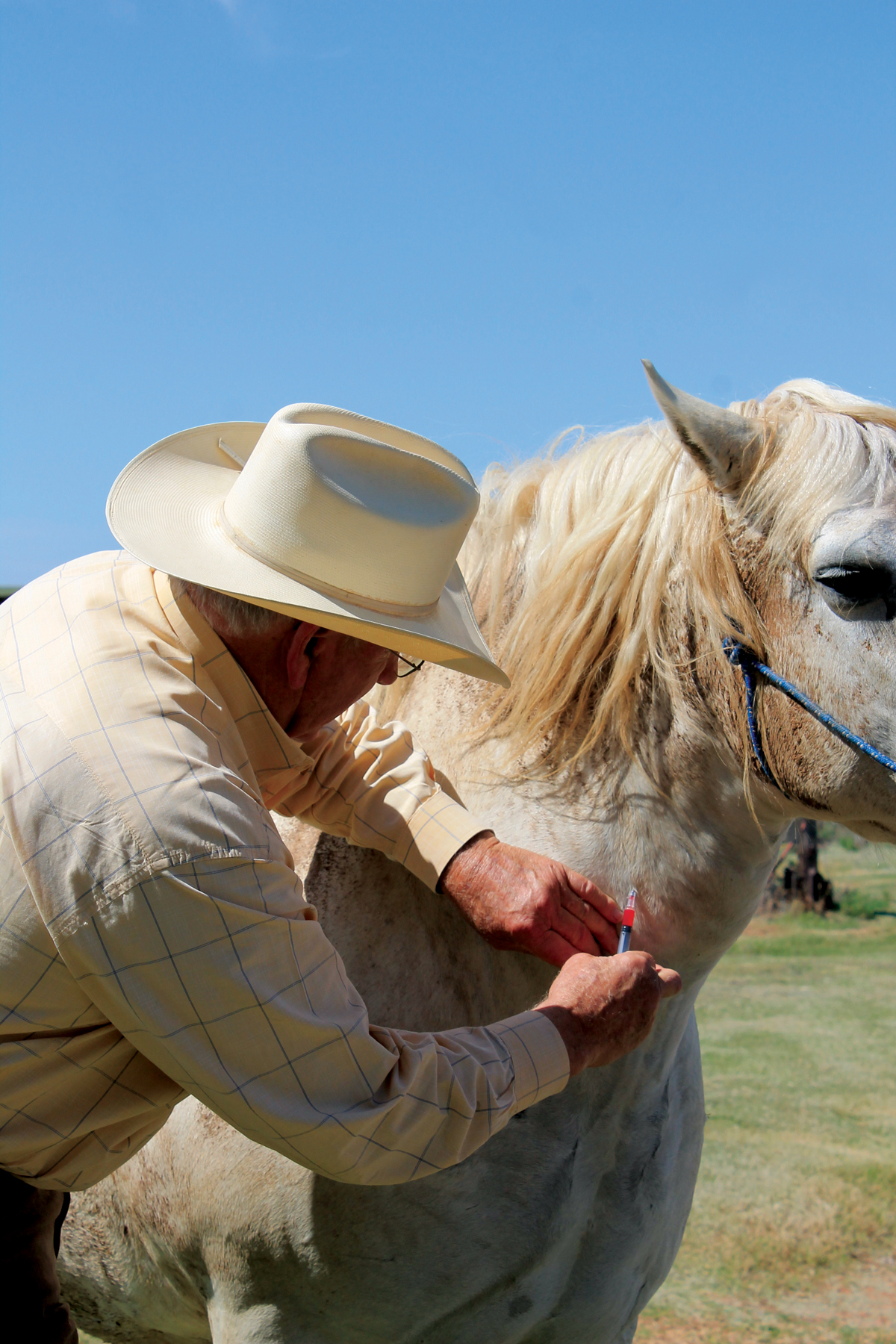
Fred Rule, DVM from Elk City, Okla., treating a horse with colic.
Unwritten Rules of a Veterinarian
By Laci Jones
The phone rings. When Fred Rule, DVM, of Elk City, Okla., answered, the veterinarian of more than 50 years sprung into work-mode. The rancher on the opposite end of the phone had a horse with colic. They began talking about symptoms and scheduling future visits. The veterinarian joked, “I don’t even buy green bananas. I don’t plan that far ahead.”
The spontaneous veterinarian was born in Kansas on Dec. 29, 1939. When he was five years old, the Rule family moved 100 miles west to Ramona, Kan., with a population of 400 people. His father worked in the “implement business” for a John Deere Dealership while his mother stayed home to take care of their five children—Judy, Fred, Janet, Jim and Kim.
An ornery boy, Rule said he always carried a knife and matches. He got a “whooping” on the first day of school in Ramona because he carved his name in the desk and started a fire in the boy’s bathroom, he laughed.
Shortly after, they moved 14 miles to a larger town called Herington, Kan. It was an agricultural- and railroad-based community of 3,000 people, he added. Rule was a smart child, but he never took notes. He was also a gifted athlete particularly in football. After graduating high school, the young athlete enrolled in Kansas State University on a football scholarship. There, the tight end had a “few rude awakenings.”
“When I got up there, I found out that there were a lot of guys who were very fast and very big,” the former football player recalled.
An injury to his left knee sidelined the young athlete, and he focused on earning a bachelor’s degree. The KSU alumnus said “for some reason” he decided to become a veterinarian when he was in eighth grade. Although Rule was raised in town, he was surrounded by farming. It is not that he disliked farming, but he said he always wanted to be a cowboy and work with livestock.
“I always said being a veterinarian was my vocation, but a cowboy is my avocation,” Rule said. “Fortunately, the two have mixed well over the years.”
Rule went to KSU with a former high school classmate named Jack Webb. Webb’s father raised quality rodeo horses, which peaked Rule’s interest saying, “That’s how we got in the rodeo business.”
However, his rodeo days were put on hold while he was in veterinary school at KSU. Kansas State University’s Veterinary School was among the elite in the United States at the time. During his six years in veterinary school, the student was exposed to hands-on learning.
“Kansas State was a very unusual school,” Rule began. “At that time, there was not a veterinarian in town in private practice. It was an unwritten law that they didn’t do that.”
The college provided veterinary service to all the surrounding farms and ranches. This allowed Rule and other veterinary students to practice before entering the field.
“When we got out of vet school, we could go to a private practice and make them money because we knew how to do it,” he added. “We didn’t need [established veterinarians] to show us how to do a lot of things. We didn’t know how to do everything by a long way, but we could do ordinary stuff.”
After receiving his DVM in 1964, the graduate moved to Holdenville, Okla. Rule said Oklahoma was known for their high-quality horses at the time, which is what he wanted to specialize in. He worked under established veterinarian Lewis Styles at his mixed-practice.
After he received his veterinary degree, Rule decided to get back in the rodeo business. He purchased his Pro Rodeo Cowboy Association card in 1966, where he tried his hand as a team roper and steer wrestler. The rodeo cowboy said he mostly “contributed to the pot.”
“I’d win something every now and then,” he laughed. “I truly enjoyed it though.”
Meanwhile, he continued to work under Styles, but there wasn’t enough work in eastern Oklahoma to satisfy the young veterinarian. Rule moved to Frederick, Okla., a few months later to work with Joe Flanigan, DVM, where he found himself in a similar situation.
At the same time, one of his former KSU classmates, Garland Hinkle, was working in Elk City, Okla., in a large practice owned by Bill Lockridge. When Lockridge decided to move to the bluegrass state, Hinkle and another veterinarian took over the practice.
They needed another veterinarian, and Rule moved to western Oklahoma by the fall of 1965. A few years later, another former KSU classmate Gail Anspaugh joined the practice. They eventually bought the other veterinarian’s share of the practice and sold a third of the practice to the third KSU alumni, Anspaugh.
“We probably have been the only three-man practice in the United States who are all classmates who have been together 50 plus years,” the distinguished veterinarian added.
The former classmates later opened a second hospital in Sayre, Okla. Anspaugh specialized in cattle, sheep and pigs, Hinkle focused on both large and small animals and Rule worked with horses 90 percent of the time. They later hired another veterinarian, Jimmy Fochs, DVM, for several years.
The veterinarian said moving to Elk City, Okla., was one of the best decisions he made. He wanted to work with good horses and his practice in western Oklahoma opened many doors for the veterinarian including the Beutlers from Elk City, Okla.
“When I came here, Beutler Brothers Lynn, Elra and Jake were a big rodeo outfit,” he added. “If you count [Rhett Beutler’s son] Jake, I’m on the fifth generation of Beutlers producing veterinary service. The whole Beutler family is pretty good friends of ours.”
Lynn Beutler was a business man who did not refer to him by name, the veterinarian recalled. Rule recalled an incident in the late ‘60s where Beutler had a bronc that was colicing. When he arrived at the Beutler’s, the business man told the veterinarian, “I’ve got a lot of money spent on this horse.”
The veterinarian oiled the bronc, sent him through the stripping chute and tried different methods. The next day, he could see the horse was not improving, which led Rule to believe the horse had “something shutting him off” where he could not pass anything. Beutler asked the veterinarian what his options were, and Rule said there’s nothing he could do except opening him up to see if he could fix it.
“At that time, our general anesthetic wasn’t worth a flip to tell you the truth,” he added. “I run him through a stripping cute, and I knocked a board over on the left side down near his flank. I gave him tranquilizer, cleaned him up, blocked him and cut a hole in his flank right up high.”
The Elk City, Okla., veterinarian found a fecolith, a large, hard fecal material, in his intestine. Rule extracted the fecolith and closed the wound. The horse never missed a meal after that, he added.
“From then on till the day [Beutler] died, I was Dr. Rule,” the veterinarian laughed.
He went to Beutler Brother Rodeos nearly every weekend, where he competed as a steer roper then go back to work. The Elk City, Okla., resident has served as the official veterinarian for the Elk City Rodeo of Champions for more than 40 years.
At the same time, Walter Merrick American Quarter Horse Association Hall of Fame member and horse owner was “in his prime,” Rule explained. Merrick had a ranch at Crawford, Okla., later adding on in Sayre, Okla.
“Of course [Walter Merrick] produced Easy Jet, Jet Smooth and all those horses,” he said. “I had the good fortune to do all the breeding work as well as furnish veterinary service to them. It’s another family that I made pretty good friends with.”
Rule said he had good luck as an equine veterinarian in western Oklahoma. Having Merrick as a client for about 40 years as well as other clients including thoroughbred owner Pete Maxwell allowed him the opportunity to work with the best horses.
“When I came here, this country was full of good horses and good horseman,” Rule added. “I learned more the first couple of years I was here than I did them good.”
Rule said he has always been involved in the community from school boards to state equine organizations. In the early ‘70s, the Oklahoma Horseman Association were instrumental in starting the organization, Prairie Mutual Racing in Oklahoma.
“I remained active in that for years. In fact, I was the president of that for several terms,” he explained. “We were involved in writing the rules of racing and putting together our excellent state-bred program.”
The goal of the organization was to represent all equine breeds. Ultimately, these breeds split off into their own organizations including the American Quarter Horse Association and the Thoroughbred Racing Association of Oklahoma, which Rule was on the board for.
After the divorce from his first wife, the Kansas native thought he would not marry again. In the late ‘80s, World Champion steer wrestler, C.R. Boucher invited Rule and fellow friend Joe Phillips to visit in remote Montana.
“Up in that country there were big ranches where they drag calves,” he said. “It was kind of a fun deal.”
Rule said they made the trip in the fall where it was -40 degrees Fahrenheit one morning. When he got down to the pen, a person who was bundled-up except for their eyes approached the cowboys.
“I couldn’t tell whether it was a male or female,” he explained. “They were just so bundled up and wanted to know if we wanted some coffee and yeah, we sure would take some. It was the first time I drank coffee with peppermint schnapps in it at 9 o’clock in the morning.”
That bundled-up person happened to be Marlene Newman, who was raised on a large, remote ranch in east-central Montana. She later moved south to the Sooner State in 1990 and married the veterinarian the following year. They have five kids from previous marriages—Justin, Toby, Jeff, Julie and Jacquae.
In 2014, the PRCA Gold Card carrying member was named the Zoetis PRCA Veterinarian of the Year. He was nominated for this prestigious award by former NFR qualifier Larry Dawson and stock contractor Bennie Beutler. With more than 50 years spent as a veterinarian, Rule has seen many changes in the veterinary field including technology and the male to female ratio.
“I didn’t get to see the best of it, technology-wise, because now the equine world has access to the same things that the human world has,” Rule said.
The male to female veterinarian ratio has changed since Rule first started practicing. In an industry that was once dominated by males, today female veterinarians outnumber male veterinarians three to one, he explained.
Rule also said the environment in which veterinarians practice has changed as far as the law. The distinguished veterinarian said they did not worry about liability, but he said that is changing.
“We just recently, a little over a year ago, because of health issues amongst my partners and myself, shut our hospitals down,” he explained.
Rule still does cool semen breeding with partner Jose Acosta, who worked for Merrick for 22 years. The honored veterinarian said he still enjoys practicing veterinary medicine. He was going to quit practicing, but his clients and friends “won’t let me.” Rule said the area needs an equine veterinarian, and he will continue to fill that role.
This article originally appeared in the August 2017 issue of Oklahoma Farm & Ranch.
Save
Save