
Country Lifestyle
The Sounds of the Country

Daylight in the country is busy. There are engines, gates, dogs, birds, wind, and people moving with purpose. Even when it feels quiet, there is usually something making noise. It is familiar noise, the kind you stop noticing because it belongs there.
Night is different.
When the sun drops and the work winds down, the sounds change. Some disappear entirely. Others step forward like they were waiting their turn. It is only then that you realize how much the land talks after dark.
The first thing most people notice is how far sound carries at night. Voices travel farther. A truck door slams a half mile away and still feels close. Coyotes sound like they are just beyond the fence, even when they are scattered across an entire section.
There are reasons for that. Cooler nighttime air is denser, allowing sound waves to move more efficiently. During the day, sunlight heats the ground unevenly, creating air layers that bend and scatter sound. At night, temperatures even out, and sound travels straighter and farther. The land does not get louder. You just hear more of it.
Coyotes are often the headliners. Their howls, yips, and barks are not random noise. They are communication. A single howl can be a location check. Group yipping can signal territory or reunite scattered pack members. What sounds like chaos is often a coordinated conversation that carries for miles.
Owls tend to follow. Great horned owls announce themselves with deep, rhythmic calls that sound older than fences and roads. Barred owls ask their unmistakable questions from creek bottoms and timber. These calls serve the same basic purpose as the coyotes’. Territory, presence, and pair bonding, all broadcast into the dark.
Insects fill the gaps. Crickets and katydids create a steady background hum that changes with temperature and season. In late summer, their calls are loud enough to drown out distant traffic. In early fall, the rhythm slows. By winter, silence settles in where that sound once lived.
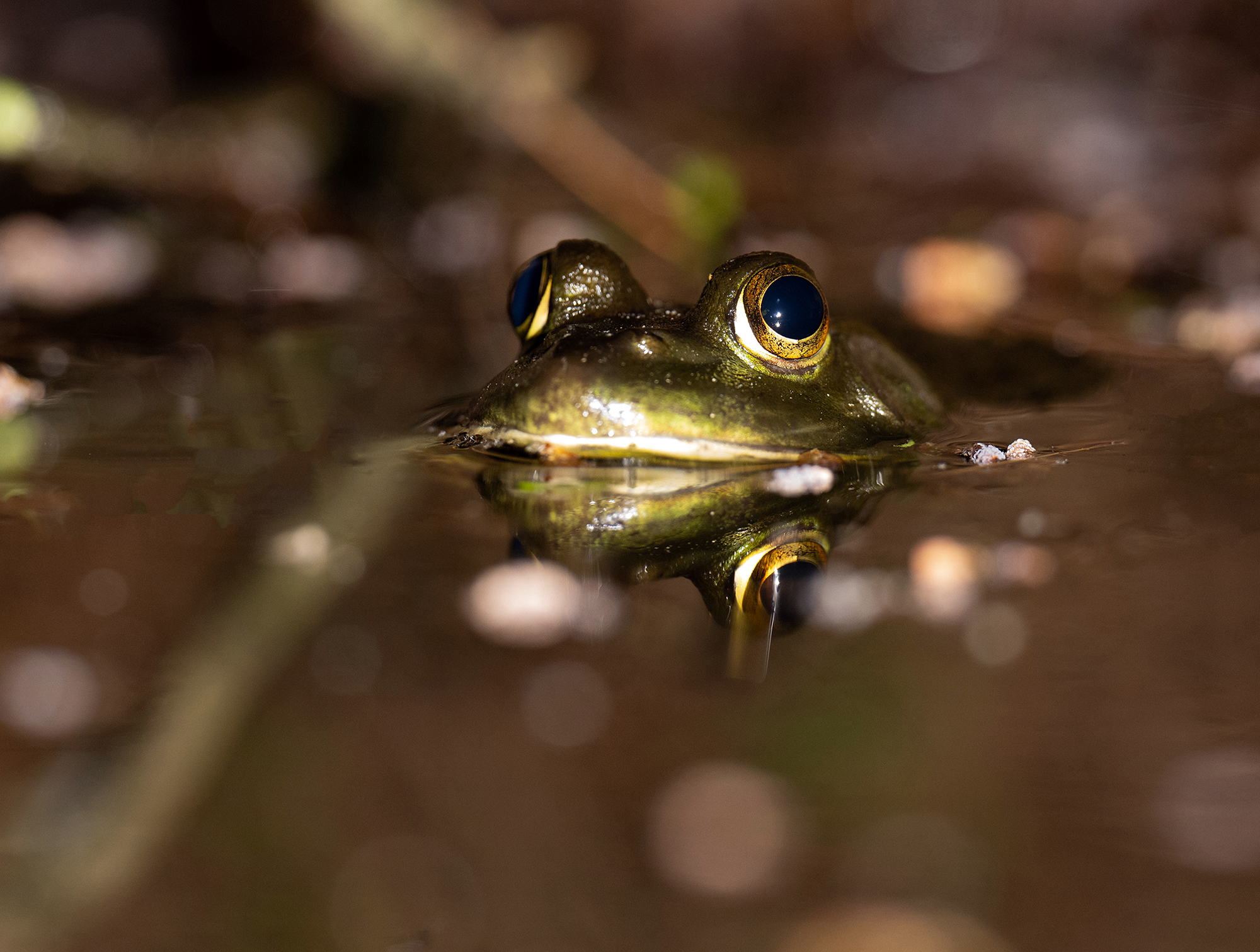
Frogs take over after rain. Stock tanks, ditches, and low spots become stages. Each species has its own call, its own timing, its own volume. To someone unfamiliar with rural nights, it can sound overwhelming. To those who live with it, it becomes reassurance that water is present and life is moving.
Livestock contribute their own nighttime sounds. A cow bawling for a calf. Horses shifting and blowing softly in the dark. The occasional thump of hooves when something unseen moves through the pasture. These noises are usually brief, but they catch your attention because they break the expected rhythm.
Some sounds are seasonal. In the fall, migrating birds pass overhead, calling to one another in the dark as they navigate by stars and landmarks. In spring, night birds return, filling the air with calls that have been absent for months. The land sounds different when life is arriving versus when it is leaving.
What surprises many people is how much quieter the country can be without human interference. With fewer buildings, less traffic, and minimal artificial lighting, natural sounds are not masked the way they are in towns and cities. Even distant highways fade into the background, leaving space for subtler noises to emerge.
That quiet can feel uncomfortable at first. Silence magnifies small sounds. A branch snapping or leaves shifting can sound larger than it is. Over time, you learn what belongs and what does not. The land teaches you what is normal.
Nighttime sounds also slow you down. There is less pressure to move, to fix, to finish. Sitting on a porch or leaning against a fence, you start to listen instead of scanning. The dark removes visual distractions, leaving only sound to tell the story.
Those sounds carry information. Weather is changing. Animals are moving. Seasons are turning. Without realizing it, you begin to recognize patterns. You notice when the coyotes are quieter than usual, or when frogs call earlier than expected. The land speaks in small signals long before anything obvious happens.
Most of these sounds go unnoticed unless you stop and listen. They are not dramatic on their own. They do not demand attention. But together, they form the soundtrack of rural life after dark.
In a world that rarely slows down, nighttime in the country offers something increasingly rare. A chance to listen without interruption. To notice what has always been there. To understand that even when the lights are off and the work is done, the land never really rests.

By Lacey Vilhauer
Ingredients: Graham Cracker Crust • 1 cup pulverized graham crackers (about 6 graham crackers, blended or food processed) • 1/3 cup butter (melted) • 1/4 cup brown sugar Brownies • 12 Tbs butter • 1 cup brown sugar (lightly packed) • 3/4 cup white sugar • 4 eggs • 1 1/2 tsp vanilla • 1/4 cup flour • 1 cup cocoa powder • 1 cup milk chocolate chips Toppings • 4 Hershey’s Bars • 10-ounce bag of mini-marshmallows
Instructions: • Preheat oven to 350 degrees Fahrenheit • Grease an 8×8 baking pan • Graham Cracker Crust • Pulverize graham crackers and stir in melted butter. Stir in brown sugar. Press into bottom of baking sheet and set aside.
Brownies In a heavy sauce pan melt butter and stir in white and brown sugars, stir over medium heat for about 1-2 minutes until sugar starts to dissolve. Remove from heat, add vanilla. Add eggs in one at a time and whisk them into the sugar butter mixture. Add flour and cocoa powder and stir together. Fold in chocolate chips. Pour brownie mixture over the top of graham cracker crust. Bake for 40 minutes. Remove from oven and turn oven to broil. Immediately put chocolate bars over the top and top them with mini-marshmallows (or cut up large marshmallows). Broil for one to two minutes (keep an eye on them so they don’t burn), remove once brown. Let cool.
By Beth Watkins
It’s that time of year again. The school supply aisles look like a cross between Black Friday and a cage fight. Parents are searching for the exact type
of blue folder required by Mrs. Johnson’s third-grade class while children toss random items into the cart like contestants on a game show.
Some moms are weeping because their baby is starting kindergarten.
Other moms are squealing tires out of the school parking
lot, headed to the nearest coffee shop on the first day, whispering, “Thank You, Jesus,” as they turn the radio up.
And truth be told, I’ve been
both.
My children have reminded me that school mornings irritated them. Their clothes were laid out the night before, either by them or by me. They weren’t fond of the routine: get up, get dressed, make the bed, brush your teeth, come in for breakfast, grab the pre-packed backpack and lunch box, and head out the door.
Once they left, I got myself ready for the day. My week of chores was always on the same schedule: laundry, shopping, Bible study, housecleaning, hobby time, and lunches with friends.
When they got home on the bus, the routine started again: • Wash your hands,
• Have a snack, • Go play, • Eat dinner, • Do homework, • Take baths, and go to bed. Unless there were dance lessons, ball practice, or church. Then those took the place of playtime.
Now, before I get myself in trouble, let me say this: I realize
motherhood looks different today than it did when I was raising my kids. Many families need two incomes. Life is expensive. Groceries cost about what a used pickup used to cost.
I understand there are moms out there juggling careers, carpools, ball games, dance lessons, church activities, homework, and trying to figure out what on earth they’re making for supper.
Y’all are carrying a load. But I do wonder sometimes if we’ve climbed aboard a merry-go- round that nobody knows how to stop.
It’s really hard to comprehend how fast time flies. We usually get eighteen years with our children. That’s 936 weeks. By the time they turn nine, half of those weeks are already gone. By the time they’re 13, there are only about 260 weeks left before adulthood. Suddenly, 18 years doesn’t seem nearly as long.
Somewhere along the way, we started believing that a good life requires more stuff, more activities, more travel, more commit
ments, more everything.
The problem is that “more” usually costs us the one thing we can never get back.
Time. Back when my kids were little, it wasn’t uncommon for most moms to be stay-at-home moms.
I realize what a gift that was. Not because I was Mother of the Year—I certainly wasn’t—but because I was there.
I was there for the skinned knees, the science projects started at 9 p.m., the teenage heartbreaks, and the endless interruptions that somehow always happened when I was trying to cook dinner.
Was every moment magical? Absolutely not. Some days I would’ve gladly traded a child or two for a nap.
But those years passed quicker than a summer thunderstorm.
Today, it’s the norm for both
parents to work. Many families feel pressure to keep running. Bigger houses. Newer cars. More vacations. More lessons. More sports. More commitments.
And maybe all those things are wonderful.
But every now and then, I want to grab the emergency brake on life and ask:
• What if we don’t need all of it?
• What if the greatest gift we could give our children isn’t another activity, another gadget, or another destination?
• What if it’s simply our presence?
• What if supper around the table is enough?
• What if playing in the backyard is enough?
• What if a Saturday with nowhere to be is enough?
The world is moving faster than a cat with its tail on fire. It
tells us we need more, do more, buy more, become more.
Maybe the secret is learning that less can sometimes be more.
More peace. More laughter. More connection. More memories. One day those little backpacks will be packed for the last time. The school pickup and drop-off line will be a memory. The house will get quiet.
Far quieter than you ever imagined.
And when that day comes, I don’t think you’ll wish you’d spent more time on the merry- go-round.
I think you’ll wish you’d spent more time watching fireflies, eating supper together, and simply enjoying the people God entrusted to you.
As for me, I wish I could go
back in time and do another round with my babies. I think I would let things go a little more. Maybe I’d let the laundry pile a little higher and the dust settle a little thicker so I could soak up more of our time together.
Don’t get me wrong. I enjoy the people my babies have grown into. I love that they have given us grandbabies—little versions of the babies I once rocked.
But in this season, my house is too quiet, and nobody needs me.
I know there are circumstances where single parents don’t have a choice but to work. I know these days many families are doing everything they can just to stay afloat. My heart isn’t to make anyone feel guilty. It’s simply to remind those of us who are blessed to have children that the ordinary moments are often the ones we’ll miss the most.
If you’re fortunate enough to have children, make time to savor every season of their lives and be fully present.
One day the backpacks will be
put away for good, the house will grow quiet, and you’ll discover what every parent eventually does—that time was the greatest gift you ever had.
At a funeral I went to recently, the preacher said something that has stayed with me. He reminded us that, for the man we were honoring, God went from being Savior to Lord.
That phrase captures a turning point in faith. When we first come to know Christ, it’s with gratitude for His saving grace. It’s personal, almost inward-looking: Jesus rescued me. He forgave me. He gave me new life. In that moment, He is our Savior.
But faith is not meant to remain only in the relief of salvation. Over time, we are called to move from simply being saved to truly being led. To call Jesus Lord is to hand Him the reins, to let Him set the course. It means the decisions we make, the way we spend our time, and even the way we handle hardship reflect His authority instead of our own desires.
That shift isn’t dramatic or loud — it’s usually lived out in the everyday. It’s choosing honesty when cutting corners would be easier. It’s setting aside pride to serve others. It’s holding firm in values even when the world says compromise. It’s forgiving, even when it costs something.
And for people who work the land or care for animals, this truth feels especially close. We know what it means to trust something bigger than ourselves — the rain, the soil, the cattle in our care. A rancher can do everything right, but at the end of the day, much is still beyond his control. Faith works the same way. We can’t stop at receiving salvation like a safety net. We have to surrender daily, trusting God to lead, provide, and direct, even when we don’t know what’s ahead.
Scripture asks it plainly: “Why do you call me, ‘Lord, Lord,’ and do not do what I say?” (Luke 6:46). The challenge is clear — it isn’t enough to know God as Savior. We are called to live with Him as Lord.
Salvation is the beginning, but lordship is the journey. And just like tending a crop or training a good rope horse, it’s a steady, daily process. Rescue is where faith starts. Surrender is where it grows strong.





-
 Country Lifestyle2 years ago
July 2017 Profile: J.W. Hart
-
 Farm & Ranch2 years ago
From Plow to Plentiful: The Most Important Inventions in Agricultural History
-
 Attractions9 years ago
48 Hours in Atoka Remembered
-
 Equine9 years ago
Umbilical Hernia
-
 Country Lifestyle5 years ago
The Two Sides of Colten Jesse
-
 Outdoors9 years ago
Grazing Oklahoma: Honey Locust
-
 Farm & Ranch8 years ago
Hackberry (Celtis spp.)
-
 Equine6 years ago
On the Road with Emily Miller-Beisel