
Equine
Navicular Disease

By Lauren Lamb, DVM
Navicular ‘disease’ is a condition that affects the navicular bone, navicular bursa, deep digital flexor tendon and/or the associated ligaments attached to the navicular bone. Navicular disease, navicular syndrome, caudal heel pain syndrome in the horse, or insert some other name, are all terms used to describe the same condition, pain in the heel region of a horse. For the purposes of this article, navicular disease will be the term used to describe pain from the heel region of a horse. Navicular region will refer to the navicular bone, associated ligaments, navicular bursa and deep digital flexor tendon.
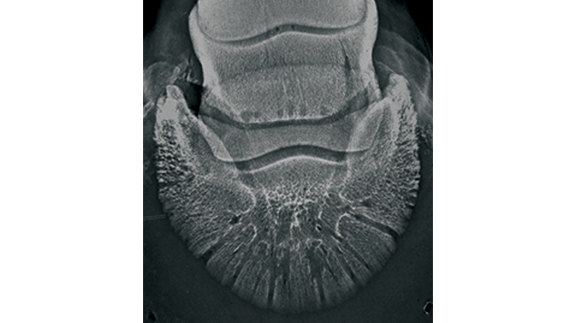
Before we can talk about navicular disease, we need to step back and review the normal anatomy. The navicular bone is located behind the coffin joint, within the hoof capsule. The navicular bone articulates (forms a joint) with the coffin bone and short pastern bone, which are located on the front side of the navicular bone.
The deep digital flexor tendon runs on the back side of the navicular bone. The navicular bursa lies between the navicular bone and the deep digital flexor tendon. The bursa is a fluid filled sac that functions as a shock absorber and a lubricant for the deep digital flexor as it passes around the navicular bone. Several other small ligaments help hold the navicular bone in place. These small ligaments are extremely important and frequently contribute to the horse’s pain.
The exact cause of navicular disease is unknown. Several potential causes for the disease have been proposed. Each theory revolves around some sort of trauma to the navicular bone and its associated ligaments, tendons or bursa. Another common theory is interference with the blood supply to the navicular bone. Navicular disease rarely develops in the hind limbs. It is predominantly seen in the front feet of a horse seven to 14 years of age. Thoroughbreds, Quarter Horses and Warmbloods are more commonly affected than other breeds. However, any breed of horse can develop navicular disease.
Lameness is the primary clinical sign seen in a horse with navicular disease. Navicular disease usually affects both front feet, but typically a horse will be more lame in the left or right leg. The lameness may only be seen with the leg on the inside of a small circle or when exercising on hard ground. The lameness will get worse with exercise and improve with rest. Typically Phenylbutazone (Bute) will improve the lameness to some degree.
Diagnosis can be challenging for a horse with navicular disease. The process of isolating the lameness to the heel region of a horse is easy and straight forward. This can be done with a temporary nerve block that will desensitize the horse’s heel. Once the lameness is localized to the heel, the real challenge of trying to identify the exact cause of heel pain begins.
Radiographs can be taken to evaluate the coffin joint, navicular bone and angles of the horse’s foot. The radiograph will provide little information regarding the soft tissue (ligaments and tendons) surrounding the navicular bone. Ultrasonography is typically used to image soft tissue structures in a horse; however, the location of the navicular bone within the hoof capsule makes ultrasound imaging challenging. The best way to image the navicular region is to use an MRI. The MRI provides the best quality imaging of both soft tissue and bone structures. The hoof wall does not influence the quality of image obtained with an MRI.
Pick up the June issue to learn more!
By OKFR Staff
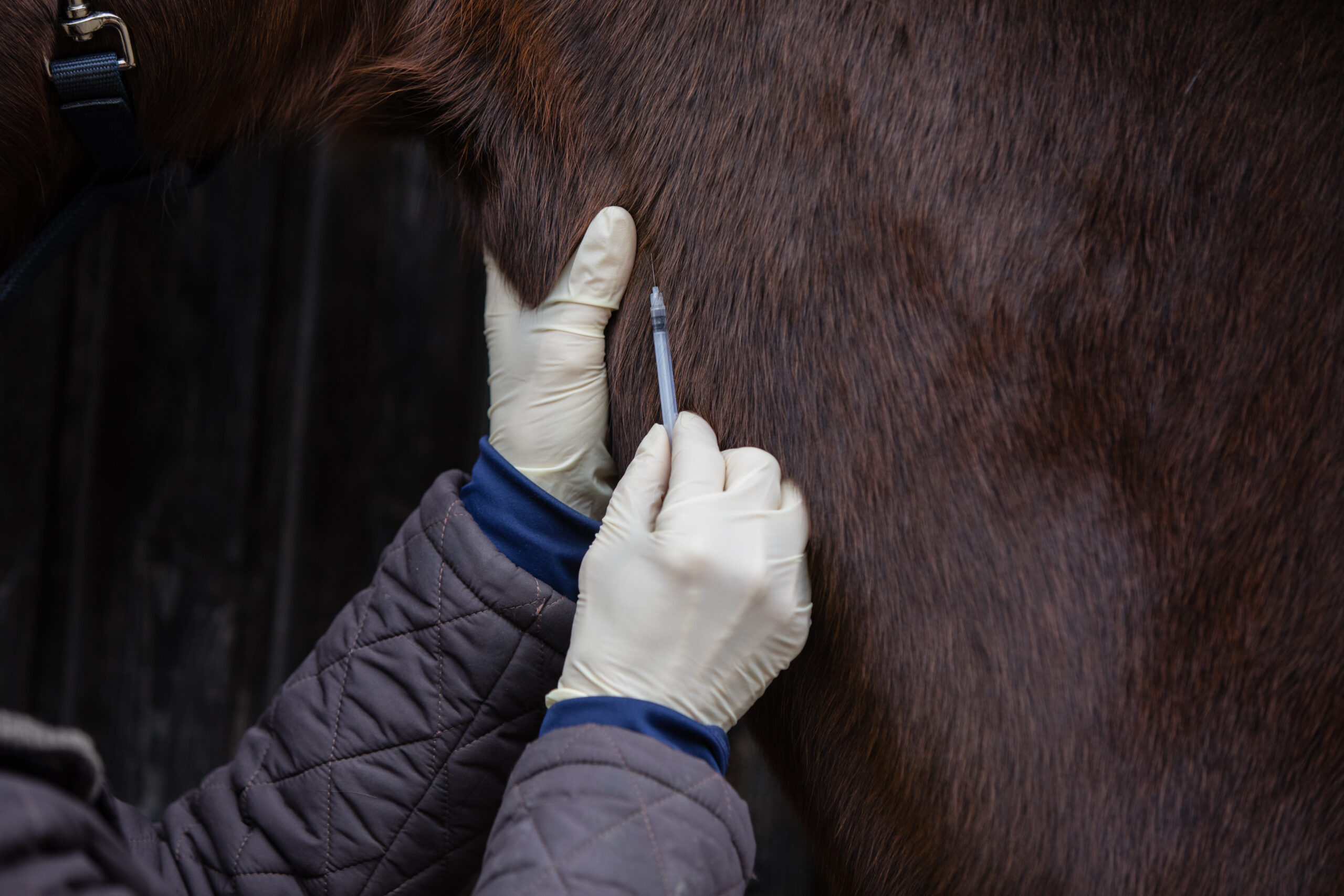
Vaccinations may not prevent every case of illness, but they remain one of the most effective tools horse owners have for reducing the risk of serious and sometimes fatal disease. The right vaccination program depends on the horse, where it lives, how often it travels and the animals it may encounter.
The American Association of Equine Practitioners divides vaccines into two categories: core and risk-based. Core vaccines are recommended for all horses because the diseases pose a significant health risk, may have public health implications or are spread by sources that owners cannot completely control.
The core vaccines for horses are tetanus, Eastern and Western equine encephalomyelitis, West Nile virus and rabies.
Tetanus is caused by bacteria commonly found in soil and manure. The organism can enter through puncture wounds, cuts, surgical sites and other damaged tissue. Even a wound that appears minor can create an opportunity for infection.
Previously vaccinated adult horses generally receive a tetanus booster annually. An additional booster may be recommended following a penetrating injury or before surgery if more than six months have passed since the horse’s last dose.
Eastern and Western equine encephalomyelitis and West Nile virus are spread primarily through mosquitoes. These diseases can affect the nervous system and may cause weakness, loss of coordination, behavioral changes, difficulty standing or death.
Vaccination is generally scheduled before mosquito season begins. In regions with long mosquito seasons, a veterinarian may recommend boosters more frequently than once a year.
Rabies is uncommon in horses, but it is fatal and can be transmitted to people. Horses may be exposed through contact with infected wildlife, including bats, skunks, raccoons and foxes. Because horses frequently interact with owners, veterinarians, farriers and other handlers, annual rabies vaccination protects more than the individual animal.
Risk-based vaccines are recommended according to a horse’s individual circumstances. These may include vaccines for equine influenza, equine herpesvirus, strangles, leptospirosis, botulism and other diseases. A horse that remains on one farm with a closed herd may have different needs than a show horse that travels regularly, shares barns with unfamiliar horses and encounters animals from several states.
Influenza and equine herpesvirus vaccines are commonly considered for horses that travel or are frequently exposed to new horses. Equine influenza spreads quickly through respiratory droplets and contaminated equipment. Horses at increased risk may need boosters every six months, and some competitions or facilities require proof of recent vaccination.
Timing also matters. Vaccines do not provide immediate protection, and an unvaccinated horse may require an initial series of two or more doses. The AAEP recommends completing the primary series and needed boosters at least 14 days before likely exposure. Waiting until the day before a show or hauling trip does not give the immune system enough time to respond.
Mild soreness, swelling or a temporary fever can occur after vaccination. Serious reactions are rare, but owners should contact their veterinarian if a horse develops significant swelling, breathing difficulty, hives, weakness or other concerning signs.
There is no single vaccination schedule that fits every horse. Age, pregnancy, health, travel, local disease activity and previous vaccination history all affect the plan.
A veterinarian can also make sure vaccines have been properly stored, administered and recorded.
Vaccination works best alongside good management. Clean equipment, limited contact with unfamiliar horses, isolation of new arrivals and prompt attention to illness remain important.
Together, vaccination and basic biosecurity provide horses with a stronger line of defense against preventable disease.
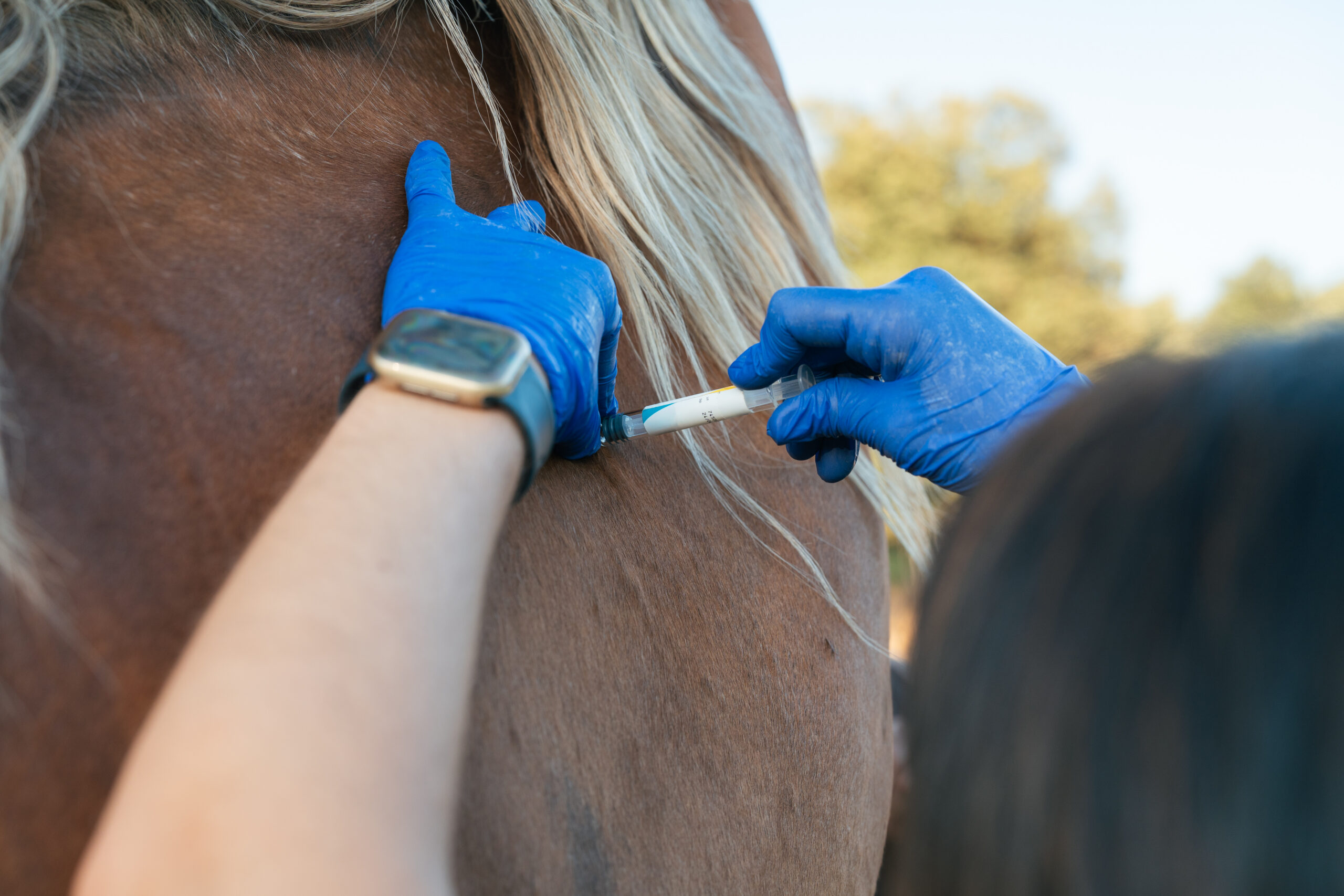
Vaccinations may not prevent every case of illness, but they remain one of the most effective tools horse owners have for reducing the risk of serious and sometimes fatal disease. The right vaccination program depends on the horse, where it lives, how often it travels and the animals it may encounter.
The American Association of Equine Practitioners divides vaccines into two categories: core and risk-based. Core vaccines are recommended for all horses because the diseases pose a significant health risk, may have public health implications or are spread by sources that owners cannot completely control. The core vaccines for horses are tetanus, Eastern and Western equine encephalomyelitis, West Nile virus and rabies.
Tetanus is caused by bacteria commonly found in soil and manure. The organism can enter through puncture wounds, cuts, surgical sites and other damaged tissue. Even a wound that appears minor can create an opportunity for infection. Previously vaccinated adult horses generally receive a tetanus booster annually. An additional booster may be recommended following a penetrating injury or before surgery if more than six months have passed since the horse’s last dose.
Eastern and Western equine encephalomyelitis and West Nile virus are spread primarily through mosquitoes. These diseases can affect the nervous system and may cause weakness, loss of coordination, behavioral changes, difficulty standing or death. Vaccination is generally scheduled before mosquito season begins. In regions with long mosquito seasons, a veterinarian may recommend boosters more frequently than once a year.
Rabies is uncommon in horses, but it is fatal and can be transmitted to people. Horses may be exposed through contact with infected wildlife, including bats, skunks, raccoons and foxes. Because horses frequently interact with owners, veterinarians, farriers and other handlers, annual rabies vaccination protects more than the individual animal.
Risk-based vaccines are recommended according to a horse’s individual circumstances. These may include vaccines for equine influenza, equine herpesvirus, strangles, leptospirosis, botulism and other diseases. A horse that remains on one farm with a closed herd may have different needs than a show horse that travels regularly, shares barns with unfamiliar horses and encounters animals from several states.
Influenza and equine herpesvirus vaccines are commonly considered for horses that travel or are frequently exposed to new horses. Equine influenza spreads quickly through respiratory droplets and contaminated equipment. Horses at increased risk may need boosters every six months, and some competitions or facilities require proof of recent vaccination.
Timing also matters. Vaccines do not provide immediate protection, and an unvaccinated horse may require an initial series of two or more doses. The AAEP recommends completing the primary series and needed boosters at least 14 days before likely exposure. Waiting until the day before a show or hauling trip does not give the immune system enough time to respond.
Mild soreness, swelling or a temporary fever can occur after vaccination. Serious reactions are rare, but owners should contact their veterinarian if a horse develops significant swelling, breathing difficulty, hives, weakness or other concerning signs.
There is no single vaccination schedule that fits every horse. Age, pregnancy, health, travel, local disease activity and previous vaccination history all affect the plan. A veterinarian can also make sure vaccines have been properly stored, administered and recorded.
Vaccination works best alongside good management. Clean equipment, limited contact with unfamiliar horses, isolation of new arrivals and prompt attention to illness remain important. Together, vaccination and basic biosecurity provide horses with a stronger line of defense against preventable disease.
When I was younger, I saw plenty of old Westerns. They were fun to watch, but one part always stressed me out. Inevitably, a cowboy would get shot or thrown from his horse, and while the cameras stayed on the fallen rider, I worried about the horse. Would it wander around lost on the prairie, never finding its way back? The truth is, most horses know exactly where home is. Turn one loose, and it will drift toward the barn. Ride one out, and the trip away from home feels steady, but the return picks up pace the moment the barn roof comes into sight. We even have a name for it: barn sour.
Horses are prey animals, and survival has always depended on familiar ground. For a domestic horse, the barn means food, water, and the company of the herd. Ethologists (scientists who study animal behavior) point out that horses are quick to learn patterns. When hay and grain appear in the same place every day, that spot becomes magnetic. Over time, repetition lays down mental trails as clearly as cattle wear down physical ones in a pasture. What appears to be stubbornness is actually instinct. The barn equals safety, and safety equals survival. Riders from cavalry days to modern ranches have written about horses quickening their pace on the way home. And though the land changes, that pull never does.
People are not so different. We all have barns in our lives — comfort zones we gravitate toward, routines that steady us. They serve a purpose. Like a horse standing at the gate, we lean on safe ground when life feels uncertain. But the pull can also hold us back. A horse that refuses to leave the yard never discovers what lies beyond the fence, and the same is true for us.
That balance shows up in history too. Old cattle trails once served their purpose, guiding herds north and helping to build economies. But when railroads and fences changed the landscape, those well-worn tracks became ruts. Progress required new paths. Our own habits work the same way. Some keep us grounded. Others only circle us back to where we started.
When I see my horses drifting toward the barn, I think less about impatience and more about instinct. They are drawn to the familiar, and so am I. The barn matters. It is the anchor point, the place of rest. But the pasture matters too, because growth is waiting outside the gate.
Those old Westerns had it right in at least one way. The cowboy’s horse was never going to wander off aimlessly. It would head back to camp, back to the barn. That simple truth still plays out in every pasture and arena today. Horses know where home is. The question is whether we will let the pull of our own barns keep us tied too tightly, or whether we will use them as a base to step farther into the wide-open ground ahead.



-
 Country Lifestyle2 years ago
July 2017 Profile: J.W. Hart
-
 Attractions9 years ago
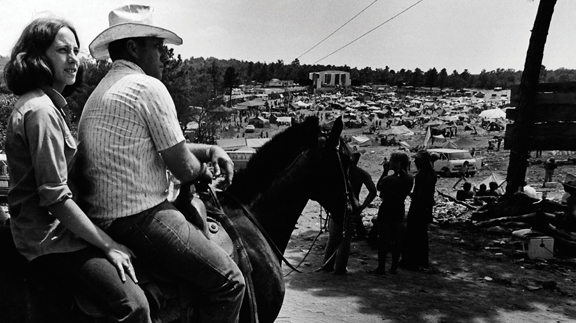
48 Hours in Atoka Remembered
-
 Farm & Ranch2 years ago
From Plow to Plentiful: The Most Important Inventions in Agricultural History
-
 Equine9 years ago
Umbilical Hernia
-
 Country Lifestyle5 years ago
The Two Sides of Colten Jesse
-
 Outdoors8 years ago
Grazing Oklahoma: Honey Locust
-
 Farm & Ranch8 years ago
Hackberry (Celtis spp.)
-
 Equine6 years ago
On the Road with Emily Miller-Beisel