
Home
Farmer uses aerial approach to planting cover crops

By Bryan Painter
SOUTH COFFEYVILLE, Okla. – Torrential rains fell in May, and radish, turnip and cereal rye seeds fell in October over Scotty Herriman’s farm.
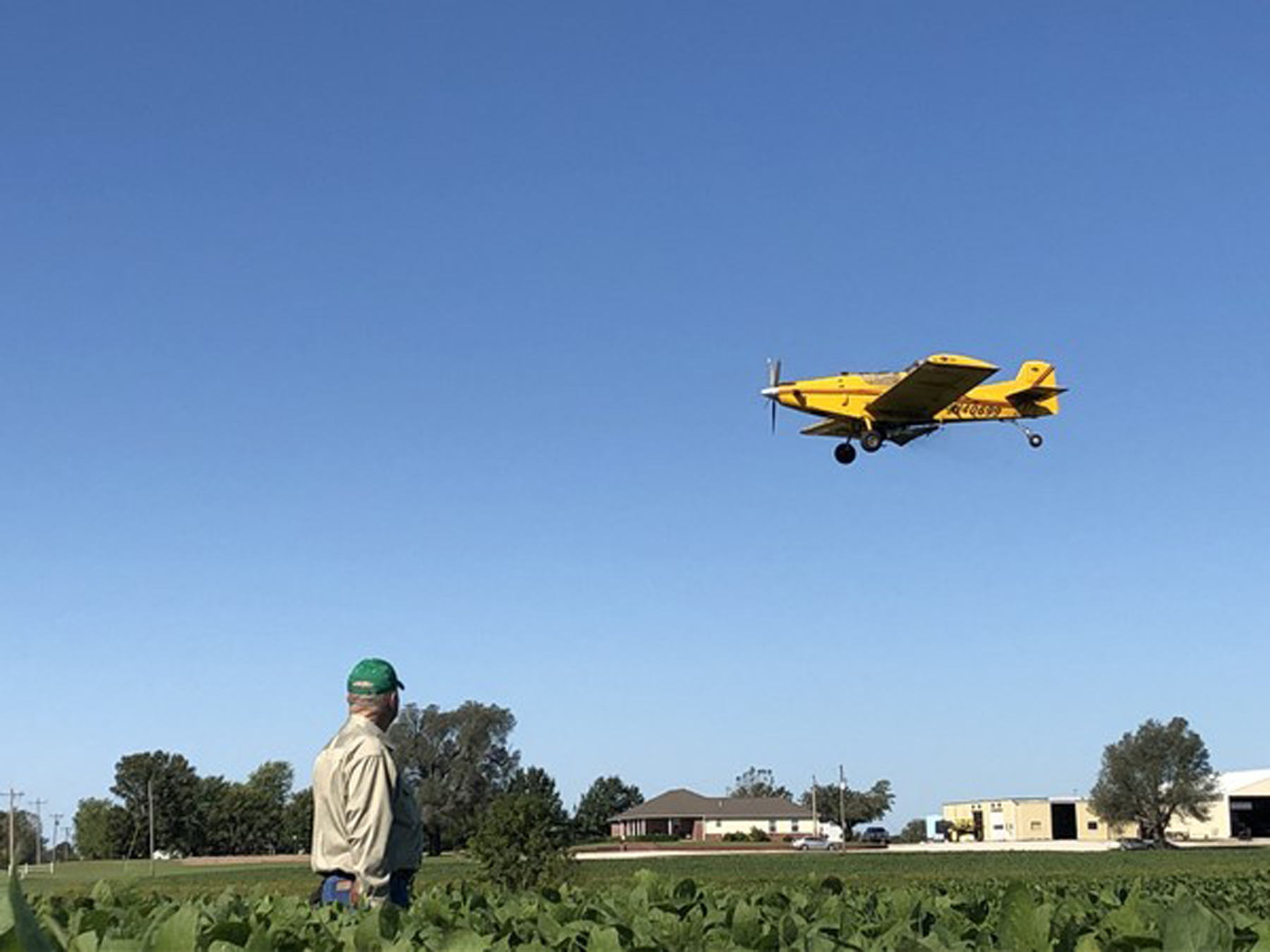
Recently Herriman stood in his soybean field about a half mile from the Verdigris River in northeastern Oklahoma as an airplane buzzed over top, about 40 feet up, dropping a cover crop mix of radishes, turnips and cereal rye upon the beans and the 70-year-old producer.
Where he stood on this day was about eight feet under water in May. His corn, knee high before the rains, was gone. Portions of some stalks, a few cobs and even the shell of a native mussel were about all that was left. However, he’d made a commitment back in March or April through the United States Department of Agriculture (USDA) Natural Resources Conservation Service (NRCS) Environmental Quality Incentives Program to plant cover crops, and his window of opportunity had just about shut and locked. He had drilled the cover crop seed on about 80 acres of already harvested upland corn, but with time of the essence, he called a flying service from nearby Miami, Okla., so that he could fly the seed in on about 480 acres of the beans.
Herriman has been farming on this particular farm for over 50 years.
In his office is a framed collage of family photos, some in black and white and others in color. Among the black and white prints is a photo of his grandfather as a child in Arkansas and another of his father at age 16 holding the reins on two “big old mules.”
As Herriman watched a plane go over head, he talked about then and now.
“We thought everything had to be plowed and disked, field cultivated, harrowed down … , but when we started no-tilling eight or 10 years ago, we could see that it will work,” Herriman said. “Now comes the flying part of it. I truly believe it will work. Yes, the difference was that none of this could have happened that long ago, but we know that you can over seed crops in ground that hasn’t been tilled and it does work.”
Herriman paused, then said, “I wish my grandpa (W.J. Herriman) and my dad (Odis Herriman) were standing here beside me because they would say, ‘Son you’re crazy. You are absolutely crazy.’ To me, it’s time to do this. I do wish they could be here. I wish they could ride on the combine with me, I wish they could do a lot with me, because they would say, ‘Wow, what is this son?’”
He grew up here in Nowata County near South Coffeyville, Okla. He respects what he was taught, and he’s never lost the willingness to learn and consider new ways.
“It’s kind of a new day for us in cover crops, but since the soil health initiative has taken place, it’s spurring me on to try some of these new things,” said Herriman, who was inducted into the Oklahoma Conservation Hall of Fame in 2012 and serves as the Area III Commissioner of the Oklahoma Conservation Commission. “Hopefully it will work here in this old black soil bottom, and we can pass that information on to others across the state, and maybe others will try it and we can spread this good news about cover crops.”
How this came to be
In the spring, Herriman signed up for the Environmental Quality Incentives Program (EQIP) that promoted cover crop adoption because he was going to have 650 acres of corn.
“It was going to be in the bottoms and prairie too,” Herriman said. “So it was going to be an easy thing for me to drill cover crops behind the corn in early September. Well, here comes the flood in May. The corn was knee high and we lose it all.”
In most places water was standing six to nine feet deep and in the draw up to 18 feet deep during an 11-day stretch in this area that is less than five miles from the Oklahoma-Kansas state line.
Farmers and ranchers often use up most of the alphabet in planning. In other words, plan A is seldom the final plan. Herriman and so many other farmers found themselves in that situation after the massive floods in May and some floods that preceded or followed.
“Well, we had to go to soybeans to have a crop,” he said. “The light came on, ‘I signed up for a program for cover crops. Now I’ve got beans and they’re not going to come off until nearly frost because they were late going in.’ So I got the idea I could fly in this cover crop and still maintain my agreement with NRCS to get these planted. The program I signed up for in the spring was to break compaction in the soil.”
At that point he had to find a “flier to fly them on.”
“When the color of the soybean leaves start to turn yellow, they are going to be dropping in about a week to 10 days,” he said. “So, we need to fly the cover crop seeds on when the soybean leaves are yellow. The leaves drop off, cover the seed up, and here comes the cover crop of turnips, radishes and cereal rye.”
Herriman was asked to explain in a little more detail how this dropping the seed as opposed to drilling it works.
“If you would try cereal rye by throwing it out on your gravel driveway, along with rain, you are going to get a stand,” he said. “On the radishes and the turnips, they recommend a quarter-inch deep when you are drilling. It’s hard to set a drill for a quarter of an inch. However, in the beans where we are flying it on, the leaf canopy from the soybeans is going to come down on top of that seed and that is going to be that quarter of an inch. Once we get a rain, it will start germinating and coming through.”
As for the soybeans, “The beans will be dried and mature and we’ll start harvesting those beans in about two to three weeks.”
Out of the clear blue sky
Herriman called Midland Flyers, based out of Miami, Okla., and on Oct. 8, on a clear, calm fall morning, two planes arrived at Herriman’s farm and went to work with precision seeding. In separate fields, they would fly from north to south then curl around and seed back the other way.
The seeds tapped the leaves of the heavily dew-covered soybeans. Most of the seed made its way to the ground immediately and the remainder got there with the help of a breeze that picked up around mid-day.
Within two and a half hours they had seeded 472 acres, and that time span included a trip for each back to Miami to load back up with seed. Herriman’s 25-pound cover crop mix consists of two pounds of turnips, three pounds of radishes and 20 pounds of cereal rye.
The pilots from Midland Flyers were Randy Wyrick and Zach Lawson, who have done this in other states.
At Herriman’s farm, Wyrick was flying an Air Tractor 802 hauling 4,990 pounds of seed, and Lawson was flying a Thrush 550, hauling 3,300 pounds of seed.
“The idea of 20 pounds of cereal rye, instead of 40 or 50, is to allow more sunshine for the turnips and radishes to grow as they should and not be overburdened with shade,” Herriman said.
So where did he come up with the idea of flying in the cover crop seed?
“Flying like this is not new to other states. It’s fairly new maybe to Oklahoma,” he said, “but I know Missouri, Indiana and Illinois, they fly on cover crops into standing corn fields for instance. When they get the corn harvested, the cover crops are flourishing quite well. It was not my choice. I would rather drill all this, but due to the flood causing the beans to be later, we had to go ahead and fly and get it coming up as the leaves start changing. I think it’s going to be beneficial.”
Herriman said he could plant the cereal rye even in November and probably still be good, but with “our deep-rooted radishes and turnips, time is of the essence right now. We had to do this as the planes were available, and the weather permitted.”
“The only way I would have done this and could have done this is with the help of NRCS,” Herriman said.
“Their EQIP Program that promotes the use of cover crops allows us the opportunity to get federal monies to try some of these things. With that three-year contract that I’m in, that’s exactly what we’re doing. We’re making it happen.”
Hope remains
This year wasn’t the first time, or even the second that Herriman had seen floods come through.
One major example came in 2007. Historic flooding to the north in southeast Kansas sent massive amounts of water into Oklahoma. Herriman had experienced floods in the 1970s and 1980s, but this one was five feet higher than the others. It destroyed their mobile home and left straw in some power lines. The Herriman family harvested 13 acres of wheat. That’s all that was left.
Herriman is quick to point out that the floods wash away crops, but not hope and faith.
“We’ve been down this path numerous times on this river, so you kind of get accustomed to the fact that it’s going to happen,” he said. “You never like it. You never enjoy it, but there is hope when you can see new crops, and you can come back. It keeps us alive and looking forward.”
As he looked down at the cover crop seed dropped minutes earlier, Herriman got a smile on his face. A familiar saying had come to mind, “My dad always said, ‘The seed won’t grow in the bag. You have to plant it.’”
So they did, from roughly 40 feet in the air.
Barry Whitworth, DVM, MPH
Senior Extension Specialist
Department of Animal & Food Sciences
Freguson College of Agriculture
Oklahoma State University
Highly Pathogenic Avian Influenza (HPAI) H5N1 continues to be a concern for backyard and commercial poultry producers. The disease has resulted in flock losses, reduced income, and trade restrictions. In September alone, eleven commercial flocks in Minnesota, North Dakota, and South Dakota were infected, along with several backyard flocks in multiple states. Since the start of the current HPAI outbreak on February 8, 2022, more than 175 million domestic birds have been lost. This total includes both commercial and backyard flocks. In addition, many wild birds have also died. Mammals have not fared any better, with numerous wild and domestic animals succumbing to the virus. As wild birds begin their southern migration, Oklahoma poultry producers need to be especially vigilant in protecting their flocks.
Avian influenza (AI) is a highly contagious viral disease. While there are many subtypes of the virus, H5N1 is classified as highly pathogenic, meaning it spreads rapidly and often causes severe illness and high mortality in chickens, turkeys, and other poultry. Wild waterfowl are natural reservoirs of the virus and can shed it without showing signs of illness, making them an ongoing threat to domestic flocks.
Clinical signs of HPAI often appear suddenly and may include:
- Sudden death with no prior symptoms
- Respiratory problems such as coughing, sneezing, watery eyes, and nasal discharge
- Decreased water and feed consumption
- Drop in egg production and/or misshapen eggs
- Swelling of the comb, wattles, head, eyelids, or hocks
- Nervous system disorders, including tremors, incoordination, and abnormal head positions
The H5N1 virus spreads through direct contact with infected birds (domestic or wild), as well as contaminated equipment, feed, water, and clothing. The virus can also travel short distances on dust particles or feathers. The risk of transmission increases during wild bird migration.
Since the United States (U.S.) has no approved treatment or vaccine for HPAI, the best defense is a strong biosecurity program. Biosecurity involves management practices designed to reduce or prevent unwanted threats from entering a flock. Key protocols include limiting traffic, keeping facilities clean, and monitoring for disease.
The first line of defense is to limit traffic on and around poultry facilities. Visitors and vehicles should not enter unless absolutely necessary. If someone must enter, they should wear clean coveralls and disposable shoe covers and wash their hands before and after visiting. All visitors should dip their shoes in a disinfectant solution upon entering and exiting. No other animals, wild or domestic, should be allowed into poultry facilities.
Sanitation is a critical part of any biosecurity plan. All equipment, feeders, waterers, and buildings should be cleaned and disinfected regularly. First, remove all fecal material and dirt. Then apply disinfectants, allowing enough contact time for them to be effective. Foot baths must be properly maintained. The property surrounding poultry houses should be mowed and kept clean. Failure to cut grass or promptly clean spilled feed can attract wild birds and animals, which have been linked to the spread of HPAI.
Birds should be monitored daily. Dead birds should be collected and disposed of promptly. Producers should be familiar with the clinical signs of HPAI. Any unusual increase in sick or dead birds should be reported immediately to the proper authorities. Poultry producers can contact their veterinarian, their Oklahoma State University County Extension office, the Oklahoma State Veterinarian at 405-522-6141, or the USDA toll-free hotline at 1-866-536-7593. Prompt reporting helps limit the spread of the disease.
Avian influenza remains a major threat to the U.S. and Oklahoma poultry industries. It is the responsibility of all commercial and backyard poultry producers to take every possible step to protect their flocks and safeguard this vital industry. For more information about HPAI, poultry producers should contact their veterinarian or their local Oklahoma State University Agricultural Extension Educator. Additional information is available at the USDA H5N1 Influenza website at https://www.aphis.usda.gov/h5n1-hpai.
Reference
Swayne, D.E. and Halvorson, D.A. 2003 Influenza. In Y. M. Saif (ed.). Diseases of Poultry, 11th ed. Iowa State Press: Ames, Iowa, 135-160.
Green, A. L., Branan, M., Fields, V. L., Patyk, K., Kolar, S. K., Beam, A., Marshall, K., McGuigan, R., Vuolo, M., Freifeld, A., Torchetti, M. K., Lantz, K., & Delgado, A. H. (2023). Investigation of risk factors for introduction of highly pathogenic avian influenza H5N1 virus onto table egg farms in the United States, 2022: a case-control study. Frontiers in veterinary science, 10, 1229008.

In today’s world, our reliance on public utilities such as electricity, water, and natural gas is undeniable. However, there is a growing movement towards greater self-sufficiency and sustainability. Many people are exploring ways to reduce their dependence on these public services, both to save money and to contribute to a more sustainable future. In this article, we’ll discuss some simple yet effective ways to reduce reliance on public utilities.
1. Generate Your Own Electricity
Generating your own electricity is one of the most significant steps towards reducing reliance on public utilities. Here are some options to consider:
Solar Panels: Installing solar panels on your roof or property can harness the power of the sun to generate electricity. Solar energy systems can provide a significant portion of your electricity needs and often come with government incentives and tax benefits.
Wind Turbines: If you have a suitable location, small wind turbines can generate electricity from wind power. Wind energy can be an excellent complement to solar panels, especially in windy areas.
Backup Generators: While not a primary source of electricity, backup generators, such as those powered by propane or natural gas, can provide power during outages and reduce your reliance on the grid.
2. Use Energy-Efficient Appliances
Upgrading to energy-efficient appliances can significantly reduce your electricity consumption. Look for Energy Star-rated appliances, LED lighting, and smart thermostats that help you manage and reduce energy use.
3. Invest in Insulation and Weatherization
Proper insulation and weatherization of your home can help maintain a comfortable temperature year-round, reducing the need for heating and cooling. Seal gaps and cracks in your home’s structure, add insulation in attics and walls, and consider energy-efficient windows and doors.
4. Collect Rainwater
Installing a rainwater harvesting system allows you to collect and store rainwater for non-potable uses, such as watering your garden or flushing toilets. This reduces your reliance on municipal water supplies, especially during droughts.
5. Compost and Reduce Food Waste
Reducing food waste not only saves money but also reduces the energy and resources needed to produce and transport food. Composting kitchen scraps and yard waste can help enrich your soil, reducing the need for chemical fertilizers.
6. Install Low-Flow Fixtures
Low-flow showerheads, faucets, and toilets can significantly reduce water usage without sacrificing functionality. These fixtures reduce water bills and ease the demand on public water supplies.
7. Practice Off-Peak Energy Use
Many utility companies offer off-peak rates, where electricity is cheaper during specific hours. Shift energy-intensive tasks like laundry and dishwashing to these off-peak hours to save money.
8. Reduce Water Heater Temperatures
Lowering the temperature of your water heater can reduce energy consumption. Most households don’t need scalding hot water, and a moderate temperature is often sufficient for daily use.
9. Switch to Propane or Natural Gas
In some cases, switching to propane or natural gas appliances can be more energy-efficient and cost-effective than electric alternatives. For example, propane-powered stoves and water heaters can provide efficient heating.
10. Install Energy-Efficient Windows and Doors
If you’re considering home renovations, invest in energy-efficient windows and doors. These can better insulate your home, reducing the need for heating and cooling.
11. Create an Energy-Efficient Landscape
Planting trees and shrubs strategically around your home can provide shade in the summer and windbreaks in the winter, reducing the need for heating and cooling.
12. Learn Basic Home Repairs
Knowing how to perform basic home repairs can help you maintain your home’s systems more efficiently. Simple tasks like fixing leaky faucets, insulating pipes, and sealing drafts can make a significant difference.
13. Consider Alternative Transportation
Reducing your reliance on public utilities extends to your transportation choices. Consider walking, biking, carpooling, or using public transportation to reduce fuel consumption and emissions.
14. Invest in Energy Storage
Battery technology has advanced, making it possible to store excess electricity generated by solar panels or wind turbines. These batteries can provide power during outages or during peak demand times when electricity prices are high.
15. Educate Yourself
Staying informed about energy-efficient practices and technologies is essential. Consider taking courses, attending workshops, or reading books and articles on sustainability and self-sufficiency.
Reducing reliance on public utilities is a journey that involves a combination of lifestyle changes, home improvements, and technology adoption. While it may not be feasible or practical for everyone to completely disconnect from public services, even small steps can lead to significant reductions in utility bills and environmental impact. Whether you choose to generate your own electricity, conserve water, or practice energy-efficient habits, every effort contributes to a more sustainable and self-reliant future. Ultimately, these changes not only benefit your wallet but also help preserve our planet for future generations.

Total Time: 4 hours
Yields: 1 1/2 Quarts
- Ice cream base:
- 6 large egg yolks
- 6 tablespoons unsalted butter
- 1 cup brown sugar
- 1/4 teaspoon salt
- 2 cups heavy cream
- 2 cups whole milk
- 1 teaspoon vanilla extract
- Pecans:
- 1 cup pecans
- 1 tablespoon unsalted butter
- Pinch salt
- Instructions:
- In a medium sized heat-safe bowl, whisk together the egg yolks until well blended. Add brown sugar and salt and mix until incorporated. Set aside.
- Pour the cream into a metal bowl set in a larger bowl of ice and set a medium-mesh sieve on top. Set aside.
- In a medium, heavy-bottomed saucepan on medium heat, melt the butter and cook it, stirring constantly, until it just begins to brown.
- Slowly add the milk, stirring to incorporate. It will foam up initially, so make sure you are using a pan with high enough sides. Do not let boil or the mixture may curdle.
- To temper the eggs, slowly pour half of the milk and butter mixture into the eggs, whisking constantly to incorporate.
Then add the warmed egg mixture back into the saucepan with the remaining milk and butter mixture.
- Stir the mixture constantly over medium heat with a wooden or heatproof rubber spatula, scraping the bottom as you stir, until the mixture thickens and coats the spatula, about 5-7 minutes.
- Add vanilla and stir until cool over the ice bath. Chill thoroughly in the refrigerator.
- While the mixture is chilling, preheat the oven to 350°F. Melt 1 tablespoon of butter. Toss with pecans and a pinch of salt. Spread pecans out on a rimmed baking sheet and bake at 350°F for 10 minutes, until the pecans are lightly toasted. Set aside to cool. Once cool, roughly chop the pecans and set aside.
- Once the ice cream mixture is thoroughly chilled, churn in your ice cream maker according to the manufacturer’s instructions.
- Once the ice cream has been formed in the ice cream maker, it will be fairly soft. Fold in the chopped pecans.
- Put in an airtight plastic container and place in the freezer for at least an hour, preferably several hours. If it has been frozen for more than a day, you may need to let it sit at room temperature for a few minutes to soften it before serving.





-
 Country Lifestyle2 years ago
July 2017 Profile: J.W. Hart
-
 Attractions9 years ago
48 Hours in Atoka Remembered
-
 Equine9 years ago
Umbilical Hernia
-
 Outdoors8 years ago
Grazing Oklahoma: Honey Locust
-
 Country Lifestyle4 years ago
The Two Sides of Colten Jesse
-
 Farm & Ranch7 years ago
Hackberry (Celtis spp.)
-
 Farm & Ranch1 year ago
From Plow to Plentiful: The Most Important Inventions in Agricultural History
-
 Country Lifestyle10 years ago
The House a Treasure Built