
Equine
Winter Colic: Why It Spikes, How to Prevent It, and What To Do If It Happens

Colic is not a single disease. It’s a broad term for abdominal pain that can range from mild gas discomfort to a surgical emergency. Winter is a time when colic cases tend to climb, and for good reason: cold snaps change how horses eat, drink, and move. For owners in Oklahoma, where one blue-skied day can turn to ice the next, paying attention to water, forage, and routine can prevent a scary midnight call—and speed help if one is needed.
Why Winter Raises Colic Risk
Reduced water intake. Horses drink less when water is icy or hard to access. Even a modest drop in intake dries the gut contents and sets the stage for impaction colic. Horses prefer lukewarm water; keeping tanks ice-free and palatable matters.
Diet shifts. Winter often means a move from fresh pasture to more hay and, on some ranches, added grain. Forage changes alter moisture content in the manure and the way feed moves through the hindgut. Abrupt diet changes and drier rations can increase colic risk. Transition feed gradually and favor consistent forage.
Less movement. Ice, mud, or pen rest can cut turnout and routine exercise. Movement is a natural driver of gut motility. When horses stand more and walk less, the intestinal tract can slow, especially if they are also drinking less and eating a different hay.
Management hiccups during cold snaps. Frozen hydrants, unfamiliar hauled water, and changes in feeding locations are common Oklahoma winter headaches. Even small shifts—a different water source taste, moving hay from pasture to a sandy lot, or a sudden jump in concentrate to “keep weight on”—can add up to trouble.
Other contributors. Dental issues, heavy parasite loads, and sand ingestion (if feeding on bare, sandy ground) don’t take a holiday in winter and can compound risk. Keep those basics current year-round.
Prevention You Can Put to Work Now
Make water easy and appealing.
Keep every trough and bucket ice-free and clean. Aim for palatable, lukewarm water—many horses drink more when water is 40–65°F. Drop-in heaters, insulated tanks, and protected cords are simple investments that pay off. Check twice a day, more often in a deep freeze.
Salt to drive thirst.
Provide plain, loose salt or a white salt block at all times. Most horses won’t overdo it, and a little extra sodium helps stimulate drinking in cold weather. If your vet approves, adding a small amount of loose salt to feed during cold snaps can help.
Keep forage consistent and high quality.
Choose a clean, mold-free hay and stick with it. If you must change hay, blend the new with the old over 7–10 days. For easy keepers or older horses with marginal water intake, soaking hay or offering a soaked beet pulp mash can add moisture to the diet.
Go slow with concentrates.
Avoid big jumps in grain to “warm them up.” If extra calories are necessary for body condition, increase gradually and split into several small meals. Sudden concentrate increases are a recognized colic risk.
Encourage movement.
Turnout is your friend. Even a few hours of relaxed walking in a paddock helps gut motility. If weather limits turnout, add hand-walking or controlled exercise on safe footing.
Feed off the sand and keep lots clean.
Use mats, feeders, or sacrifice areas with footing to reduce sand ingestion. Sand burdens can smolder all winter and show up as colic when drinking drops.
Stay on top of dental and deworming.
Poor chewing leads to larger, drier feed particles and impaction. Keep up with dental checks. Follow your veterinarian’s parasite control plan; a winter larval “bloom” in some situations can add risk.
Mind routine.
Horses thrive on predictable schedules. Keep feeding and turnout times steady, even when the weather is ugly. If your water source changes—say you’re hauling water—some horses drink less until they accept the new taste. Monitor intake closely in those periods.
Know the early signs.
Pawing, looking at the flank, getting up and down repeatedly, reduced interest in feed or water, less manure, loose or very dry manure, reduced or absent gut sounds, sweating, elevated heart rate, abnormal gum color, or depression are red flags. Treat any abnormal behavior as a warning sign.
If You Think Your Horse Is Colicking: A Step-by-Step Plan
1) Call your veterinarian immediately.
Do not “wait and see” through a winter night. Many colics are time-sensitive, and early treatment is often simpler and less costly. While you wait, gather useful information.
2) Do a quick, safe basic check.
Note attitude and pain level. Count heart rate and respiration, take a rectal temperature if it’s safe, listen for gut sounds, and look at gum color and moisture. Share these findings with your vet; they help triage the case over the phone. If the horse is in severe pain or thrashing, prioritize safety and keep them from injuring themselves until help arrives.
3) Remove feed.
Pull hay and grain. You can offer small sips of clean, lukewarm water unless your veterinarian advises otherwise.
4) Walk, don’t work.
Light hand-walking can reduce rolling and may stimulate motility for very mild gas colic, but never exhaust a painful horse or “work it out.” If walking increases distress, stop and wait for your vet’s instructions.
5) Keep them warm and safe.
Wet or shivering horses burn energy and may drink less. Use a dry blanket if the horse is cold or wet and standing quietly. Avoid deep bedding or slick aisles that encourage rolling.
6) Don’t medicate without guidance.
Avoid giving painkillers, mineral oil, or home remedies unless your veterinarian instructs you. Pain meds can mask symptoms your vet needs to evaluate, and oral products are not appropriate for every colic type.
7) Prepare for transport if advised.
If referral is recommended, have a safe, ready trailer and a plan for winter roads. Keep your horse’s Coggins and paperwork handy to avoid delays.
Practical Checkpoints for Cold Spells
Trough audit: Before a front, test every heater and replace worn cords. Have a plan for hauling water if hydrants freeze.
Intake logs: In deep cold, jot down approximate daily water levels and manure output. A sudden drop in either is a warning sign.
Hay stash: Keep at least a week of the same hay on hand to ride out supply hiccups.
Contact sheet: Tape your vet’s number to the feed room door along with barn directions and gate codes for anyone helping in an emergency.
Winter colic prevention hinges on three controllables: water, forage consistency, and routine. Keep water ice-free and appealing, transition feed gradually, encourage movement, and watch for the subtle changes that signal a problem. If your gut says something is off, call your veterinarian and act. Quick recognition and prompt care save horses.
References
American Association of Equine Practitioners (AAEP). “10 Tips for Preventing Colic.”
Oklahoma State University Extension. “Optimizing Water Intake” (AFS-3931).
Oklahoma State University Extension. “Feeding Management of the Equine.”
OSU Agriculture News. “Horse owners need to be watchful for signs of colic.”
UC Davis School of Veterinary Medicine, Horse Report. “Colic Happens.”
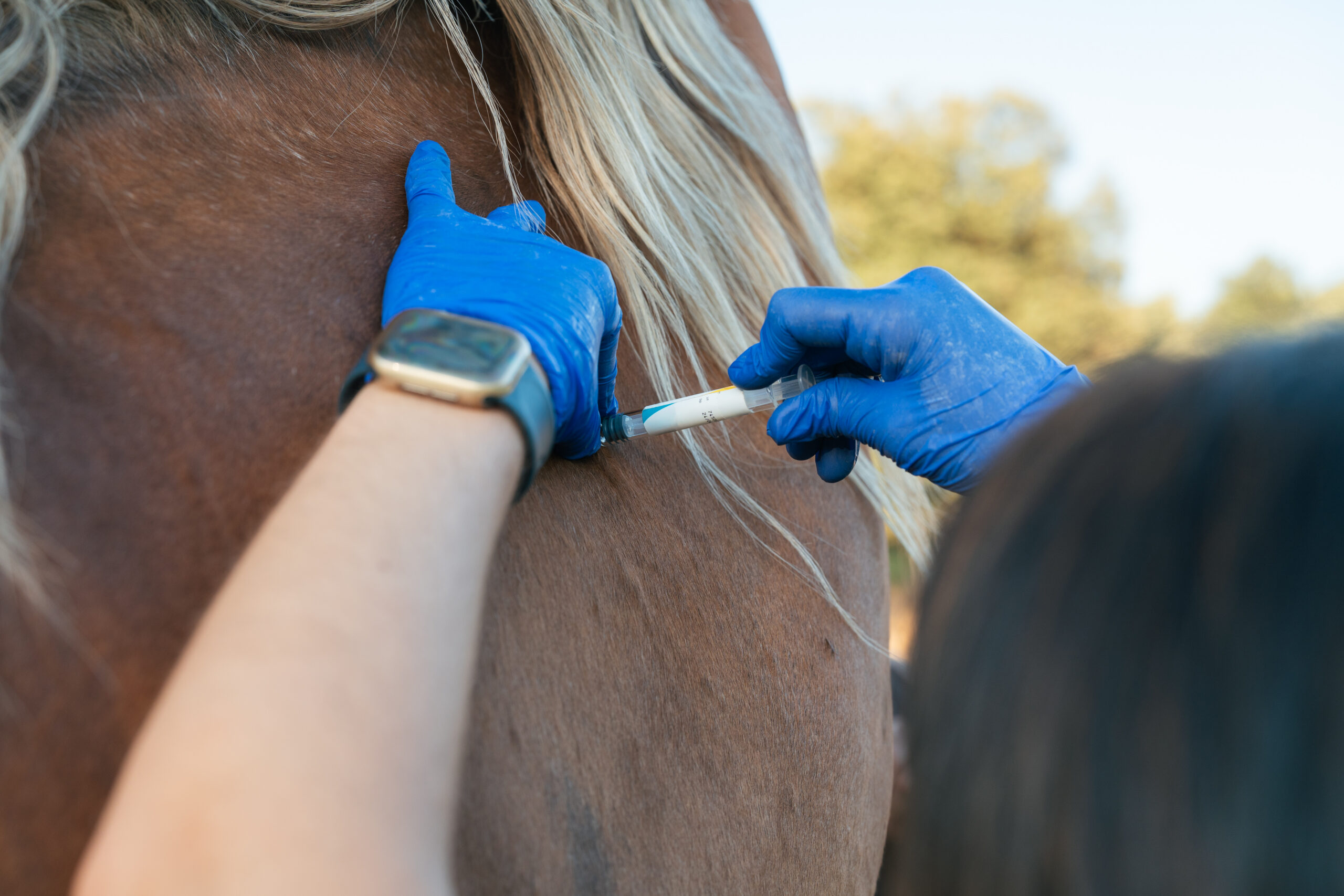
Vaccinations may not prevent every case of illness, but they remain one of the most effective tools horse owners have for reducing the risk of serious and sometimes fatal disease. The right vaccination program depends on the horse, where it lives, how often it travels and the animals it may encounter.
The American Association of Equine Practitioners divides vaccines into two categories: core and risk-based. Core vaccines are recommended for all horses because the diseases pose a significant health risk, may have public health implications or are spread by sources that owners cannot completely control. The core vaccines for horses are tetanus, Eastern and Western equine encephalomyelitis, West Nile virus and rabies.
Tetanus is caused by bacteria commonly found in soil and manure. The organism can enter through puncture wounds, cuts, surgical sites and other damaged tissue. Even a wound that appears minor can create an opportunity for infection. Previously vaccinated adult horses generally receive a tetanus booster annually. An additional booster may be recommended following a penetrating injury or before surgery if more than six months have passed since the horse’s last dose.
Eastern and Western equine encephalomyelitis and West Nile virus are spread primarily through mosquitoes. These diseases can affect the nervous system and may cause weakness, loss of coordination, behavioral changes, difficulty standing or death. Vaccination is generally scheduled before mosquito season begins. In regions with long mosquito seasons, a veterinarian may recommend boosters more frequently than once a year.
Rabies is uncommon in horses, but it is fatal and can be transmitted to people. Horses may be exposed through contact with infected wildlife, including bats, skunks, raccoons and foxes. Because horses frequently interact with owners, veterinarians, farriers and other handlers, annual rabies vaccination protects more than the individual animal.
Risk-based vaccines are recommended according to a horse’s individual circumstances. These may include vaccines for equine influenza, equine herpesvirus, strangles, leptospirosis, botulism and other diseases. A horse that remains on one farm with a closed herd may have different needs than a show horse that travels regularly, shares barns with unfamiliar horses and encounters animals from several states.
Influenza and equine herpesvirus vaccines are commonly considered for horses that travel or are frequently exposed to new horses. Equine influenza spreads quickly through respiratory droplets and contaminated equipment. Horses at increased risk may need boosters every six months, and some competitions or facilities require proof of recent vaccination.
Timing also matters. Vaccines do not provide immediate protection, and an unvaccinated horse may require an initial series of two or more doses. The AAEP recommends completing the primary series and needed boosters at least 14 days before likely exposure. Waiting until the day before a show or hauling trip does not give the immune system enough time to respond.
Mild soreness, swelling or a temporary fever can occur after vaccination. Serious reactions are rare, but owners should contact their veterinarian if a horse develops significant swelling, breathing difficulty, hives, weakness or other concerning signs.
There is no single vaccination schedule that fits every horse. Age, pregnancy, health, travel, local disease activity and previous vaccination history all affect the plan. A veterinarian can also make sure vaccines have been properly stored, administered and recorded.
Vaccination works best alongside good management. Clean equipment, limited contact with unfamiliar horses, isolation of new arrivals and prompt attention to illness remain important. Together, vaccination and basic biosecurity provide horses with a stronger line of defense against preventable disease.
When I was younger, I saw plenty of old Westerns. They were fun to watch, but one part always stressed me out. Inevitably, a cowboy would get shot or thrown from his horse, and while the cameras stayed on the fallen rider, I worried about the horse. Would it wander around lost on the prairie, never finding its way back? The truth is, most horses know exactly where home is. Turn one loose, and it will drift toward the barn. Ride one out, and the trip away from home feels steady, but the return picks up pace the moment the barn roof comes into sight. We even have a name for it: barn sour.
Horses are prey animals, and survival has always depended on familiar ground. For a domestic horse, the barn means food, water, and the company of the herd. Ethologists (scientists who study animal behavior) point out that horses are quick to learn patterns. When hay and grain appear in the same place every day, that spot becomes magnetic. Over time, repetition lays down mental trails as clearly as cattle wear down physical ones in a pasture. What appears to be stubbornness is actually instinct. The barn equals safety, and safety equals survival. Riders from cavalry days to modern ranches have written about horses quickening their pace on the way home. And though the land changes, that pull never does.
People are not so different. We all have barns in our lives — comfort zones we gravitate toward, routines that steady us. They serve a purpose. Like a horse standing at the gate, we lean on safe ground when life feels uncertain. But the pull can also hold us back. A horse that refuses to leave the yard never discovers what lies beyond the fence, and the same is true for us.
That balance shows up in history too. Old cattle trails once served their purpose, guiding herds north and helping to build economies. But when railroads and fences changed the landscape, those well-worn tracks became ruts. Progress required new paths. Our own habits work the same way. Some keep us grounded. Others only circle us back to where we started.
When I see my horses drifting toward the barn, I think less about impatience and more about instinct. They are drawn to the familiar, and so am I. The barn matters. It is the anchor point, the place of rest. But the pasture matters too, because growth is waiting outside the gate.
Those old Westerns had it right in at least one way. The cowboy’s horse was never going to wander off aimlessly. It would head back to camp, back to the barn. That simple truth still plays out in every pasture and arena today. Horses know where home is. The question is whether we will let the pull of our own barns keep us tied too tightly, or whether we will use them as a base to step farther into the wide-open ground ahead.
By Janis Blackwell
As the season arrives to gear up for participation in your equine event of choice, one thing remains a constant for all horse owners. That constant is our responsibility to insure the safety of our horses by being diligent to maintain the integrity of the trailers in which we haul them. There are a number of things that can be dangerous both inside and outside of your trailer. Whether you traveled all winter long or whether your trailer sat unused or was used very little through the cold weather months, at least once a year your trailer is due a thorough going over. So here we go with a checklist that will help you insure a happy and safe trip for you and your equine partner.
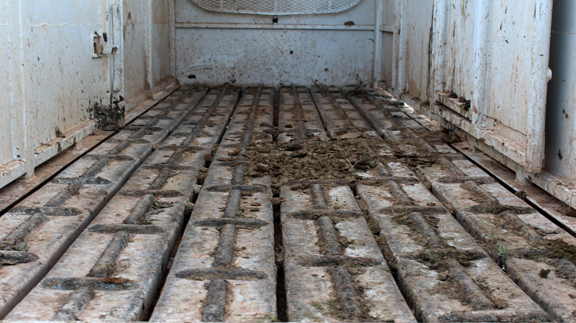
- A sound floor is absolutely imperative. Whether your floor is aluminum, steel or wood, it should be cleaned regularly after use to preserve it. Urine and manure will erode and weaken all types of floors. Even rubber mats will not prevent erosion of your floor. (Maintenance tip: remove mats and wash aluminum floors often to prevent erosion.)
- Especially check wooden floors for rotten boards. Immediately replace questionable flooring before hauling. (Maintenance tip: For wood, remove mats and wash out manure and debris. Coat wooden floor in a cheap motor oil. Allow to sit in hot summer weather until the oil soaks in. Be careful—floor will be slippery until oil cures into the wood. This treatment yearly will preserve a wooden floor for much longer than normal as it repels urine and protects the wood).
- Keep the interior and exterior washed to enable you to check for rusted out places, leaks, etc.
- Have a professional check your brakes at least once yearly to be sure they are operating properly.
- Be sure tires are inflated to the proper air pressure, and check the inside of each tire for hidden unusual wear that could cause a blowout. Replace worn tires before leaving home.
- Wheel bearings must be checked and packed at least once a year. This should be done even if the trailer has been rarely used since the last time the wheel bearings were packed. In fact, trailer maintenance professionals say that sitting stationary and unused is even worse for the bearings. Improper care and maintenance of wheel bearings can cause a wheel to seize up and actually twist off while in use. Use a horse trailer professional for this maintenance task.
- Axles should be checked for bowing. A bent or bowed axle can cause excessive tire wear and damage wheel bearings.
- There should be no more than two inches in height difference from the front of the trailer to the back. More difference than that causes the bulk of weight of the trailer and its contents to ride mostly on the rear axle causing it to bow and wear on both tires and wheel bearings.
- Another critical part of the trailer to keep an eye on are the butt chain or bar and the back door. The butt chain or bar should be firmly attached to the wall and its keeper and should always be latched. The door should have a strong secure latch with a pin to insure it stays latched while in motion.
- Finally, but certainly not of least importance is a thorough check of the trailer hitch including ball and coupling. Keep the ball well greased. Periodically, check to see that the ball is still securely tightened and the latch on the coupling is working properly.
These few critical safety check points can save you money, stress and the wellbeing of your horse. Until next time, happy trails and safe traveling.
This article was originally published in the April 2016 issue of Oklahoma Farm & Ranch.



-
 Country Lifestyle2 years ago
July 2017 Profile: J.W. Hart
-
 Attractions9 years ago
48 Hours in Atoka Remembered
-
 Farm & Ranch2 years ago
From Plow to Plentiful: The Most Important Inventions in Agricultural History
-
 Equine9 years ago
Umbilical Hernia
-
 Country Lifestyle5 years ago
The Two Sides of Colten Jesse
-
 Outdoors8 years ago
Grazing Oklahoma: Honey Locust
-
 Farm & Ranch8 years ago
Hackberry (Celtis spp.)
-
 Equine6 years ago
On the Road with Emily Miller-Beisel