Attractions
The Worsham Ranch House

By Jessica Crabtree
North Texas is home to a vast amount of historical real estate. Clay and Montague Counties are no exception. Today a visit to the acclaimed Clay County Museum will validate the large ranches, homes and names to go with each. One name recognizable to most is Worsham. W.B. Worsham, the (patriarch)of the family, was best known for his prominent position as a banker and rancher. At one time, it is said, that the Worshams owned a good portion of the land that extends from Ringgold to Henrietta.
When he came to Clay County, Worsham’s net worth totaled $3,000. At his death, due to his ranching interests amounting in excess of 25,000 acres and other properties in neighboring counties and financial investments, his estate estimated his worth to be $3,000,000. To show his prominence, Worsham was president of the bank of W.B. Worsham & Co. of Henrietta, a director in the American Exchange National Bank and the Dallas Brewery of Dallas and the Cassidy Southwestern Commission Company of Ft. Worth, Kansas City and St. Louis.
Since he had two children, one can assume that the family’s interests were passed down to the children. Worsham’s son Carl Madison Worsham followed in his father’s footsteps with his trade being in banking and ranching. Carl was born in Henrietta in August of 1881. Raised in Henrietta, Carl married Mae Easley Worsham and had two children. Although history sometimes gets lost, Carl was associated with a home other than one in Henrietta. That home was a lavish ranch house in Ringgold.
The construction took place between 1916 and 1919 south of Ringgold. The house was a 3,000 sq. foot home, but considering its three stories, the home was approximately 9,000 sq. feet. The entire home was built with a European influence. The tall walls of the home were made of English walnut extending to 10 to 12 ft. ceilings. In various rooms throughout the house, the walls held numerous secret compartments of all sizes. One can assume they were to hide items of great value. The tongue and groove floors, imported from England, were one inch thick. Not only were the floors imported, but so were the chandeliers. The house was adorned with Greek or Roman statues, great French doors and large, beautiful fireplaces. Totaling seven, two were adorned with tile made with intricate detail. One fireplace portrayed the scene of a wagon train and another a peacock of rich purples, greens and blues.
The massive structure was a grand display for its day and time. The first floor consisted of a kitchen with an indoor water well and hand pump, a parlor, grand living room, sitting room for reading, a gun room, one bedroom, one bathroom and a sunroom. The first floor was complete with a dumbwaiter used to send food up to the dining room above. The second floor began with a grand stair case. The stair case led into a hallway that ran north and south with a formal dining room going east and west. The second floor had four bedrooms with two arranged on either side the dining room. Between each pair of bedrooms was a bathroom. The bathroom showers where said to have had 16-shower heads, with four coming from each corner. There was also a balcony off the east side of the house.
The third floor, perhaps the most intriguing, was a dance floor. The third floor was one large room with a sloped ceiling. On two sides were small cubicles with doors between them for easy access. The basement was an area with few visitors. It housed the massive boiler that heated the home as well as the central vacuum system. The basement was connected to the cellar by a thick, five-foot cement hall way. The cellar, a cool place, was used mostly as a root cellar for onions and potatoes. It was also a perfect haven for snakes and spiders (more on that later).
The outside was outlined with red clay tiles as a walk-way. The tile resembled that of Mexican terra cotta tiles. Surrounding the house was a manicured lawn where shrubs and cedar trees were cut to look like an English garden
Bettye Hanson had first-hand experiences with the home. Her late husband, S.L. Hanson, moved with his family to the home in 1945 when he was in the seventh grade. His father, Noah Hanson, worked for Wilmer Seay as foreman for the Seay ranch. Wilmer Seay bought the 4,000 acre Worsham Ranch from the Carl Worsham Creditors Committee in 1938. Sparing no expense, it is said that Worsham went bankrupt over building and maintaining the home. It was also during the onset of the great depression. Worsham died Sept. of 1935 at the age of 54.
Bettye recalled the third floor, having had dances in it and roller skating parties. She and S.L.’s wedding reception was in the parlor of the home in 1955. To her recollections, the house was a grand structure, but she admitted as young kids do, she thought little of it. She remembered stories her husband told of the home. In a sit-down talk with her and her three sons who later spent time at the home, they said their father, S.L., would get off the school bus and wait outside until one of his parents came home. He and his mother, Lois, known to the family as Nanny, were convinced the house was spooky (more on that later as well).
S.L. passed away in 2008, but his wife and three sons are left to tell the stories of growing up in the Worsham ranch house. Bettye said the home was vacant until the Hansons moved in 1945. When they arrived, the home was still the mirror image of lavish living. Bettye said Nanny told her of bear rugs on the floors. Bettye said for the time, the Hansons were one of the first in the country to get a television. The Hansons had a telephone, but it was a party line. Bettye said Nanny would get aggravated talking to others when nosey people listened in on the conversation.
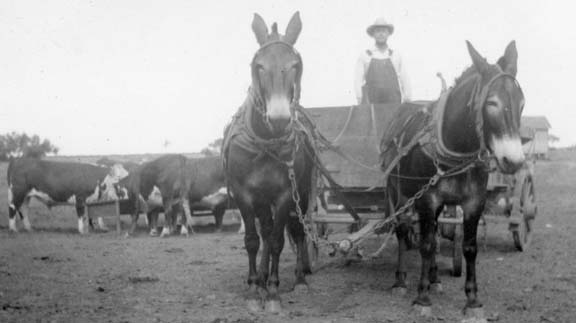
Every weekend for almost 30 years the three Hanson boys, Kent, Steven and Rick, spent their time at the Worsham ranch helping their Papa, Noah. Their memories of the Worsham ranch house are priceless. They said of their grandpa that he had a way with training animals, especially with his team of mules that he would back into the barn to fill a wagon full of feed to use feeding cattle. Another fond memory was all the snakes on the ranch. The boys all remember the time their Papa was bathing and a snake came through the spout of the bathtub and into his lap. Nanny was bit by a rattlesnake while pulling weeds in the front yard. At one point, an exterminator swore he would never revisit the home due to all the snake sheds.
The three boys remember walking the hallway between the basement and cellar. The home was pier and beam. After they reached a certain height, the young boys would walk crouched down to ensure no snake lunged at them from top of the hallway wall. Rick remembered you could see over the wall into the piers and beams of the house. Besides storing onions and potatoes in the cellar, their Nanny also stored canned goods in it. Often in the cellar she would find the door open and objects and articles of clothing that didn’t belong to them. It was thought that drifters would take refuge in the cellar over night.
Although the ranch life was work, the Hansons hold those times as the fondest of memories. The massive structure was remolded in 1956. The top two floors were too costly to heat and were removed. Through the years the home had other renovations, but the first story still stands today and is owned by Wilmer Seay’s daughter, Sue Seay Dennis as mentioned in the January NTFR issue. Stories of the house being haunted have been passed down generations. The Hanson brothers recall their Nanny telling them to stay out of the front part of the house because it was haunted, but that warning was probably to keep rambunctious boys sitting idle. The story of a man roaming the property in a white shirt, whether walking or horseback, has been told by many. A woman who lived in the home after the Hansons swore to seeing a man she was convinced was Worsham. Ghost or no ghost, little was published about the home. The lavish, large-scale home was definitely built to entertain and make a statement and is worthy of exposure to educate people of its existence.
By Lindsey Monk
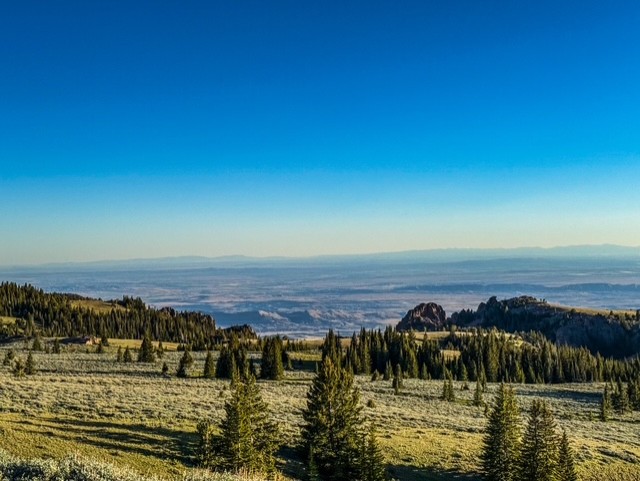
When the summer sun is blazing in the hayfields, a scenic drive into the mountains offers cooler air, stunning views and a welcome break from the heat.
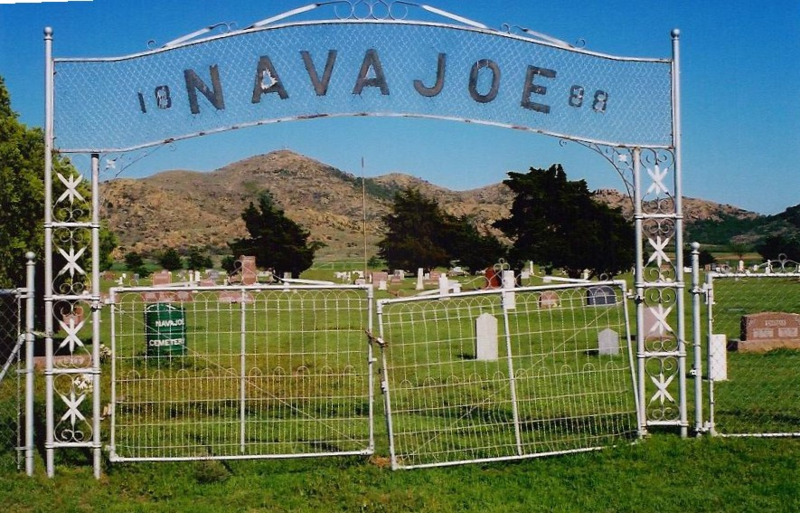
Southwestern Oklahoma is rich with history and has a beautiful, rugged landscape. A lesser known mountain range, the Navajo Mountains sits in eastern Jackson County, just to the north east of Altus.
There, at the base of those mountains, used to be the town of Navajoe. It’s easy to surmise that the town took its name from the nearby mountains. As a side note, from my research, it seems that the Navajo Mountains got their name because of a failed Navajo raid. According to folklore, the Navajos attempted to steal Comanche horses, and were annihilated by the Comanches. Legendary Comanche Chief Quanah Parker gave a detailed account of a similar failed Navajo raid in 1848 or 1849, against his village in Elk Creek just north of the mountains.
Approximately 40 years later, in 1886 when the area was still part of Greer County, Texas, two men named W.H. Acers and H.P. Dale opened a general store in the area. The next year, “Buckskin Joe” Works, a Texas land promoter, attended a Fourth of July picnic in the area. The celebration included settlers, cowboys, and several Comanches led by Quanah Parker.
That same year, the town received a post office designated as “Navajoe” to avoid confusion to Navajo, Ariz. Around the same time the Navajoe school opened, and a couple churches were founded.
Eventually the town was home to more than 200 families, and had a booming trade center, complete with grocery stores, hardware stores, saloons, a blacksmith, a dry goods store, a hotel, and a cotton gin. It was a regular frontier time.
Unfortunately, in 1902, the railroad eventually bypassed Navajoe, ensuring its demise, as most businesses moved – buildings and all. Less than two decades later the Navajoe School was consolidated with Friendship and other school districts. Now, all that remains of the town is a small cemetery at the foot of the mountains. A granite monument, which was fashioned in 1976, pays tribute to the old town.
Eventually, in the mid-1960s, Friendship and Warren schools consolidated. The new school, which graduated its first class in 1964 and is still active in Jackson County, is called Navajo.
Read more in the February 2020 issue of Oklahoma Farm & Ranch.
Sources
Wikipedia.com
RedDirtChronicles.com
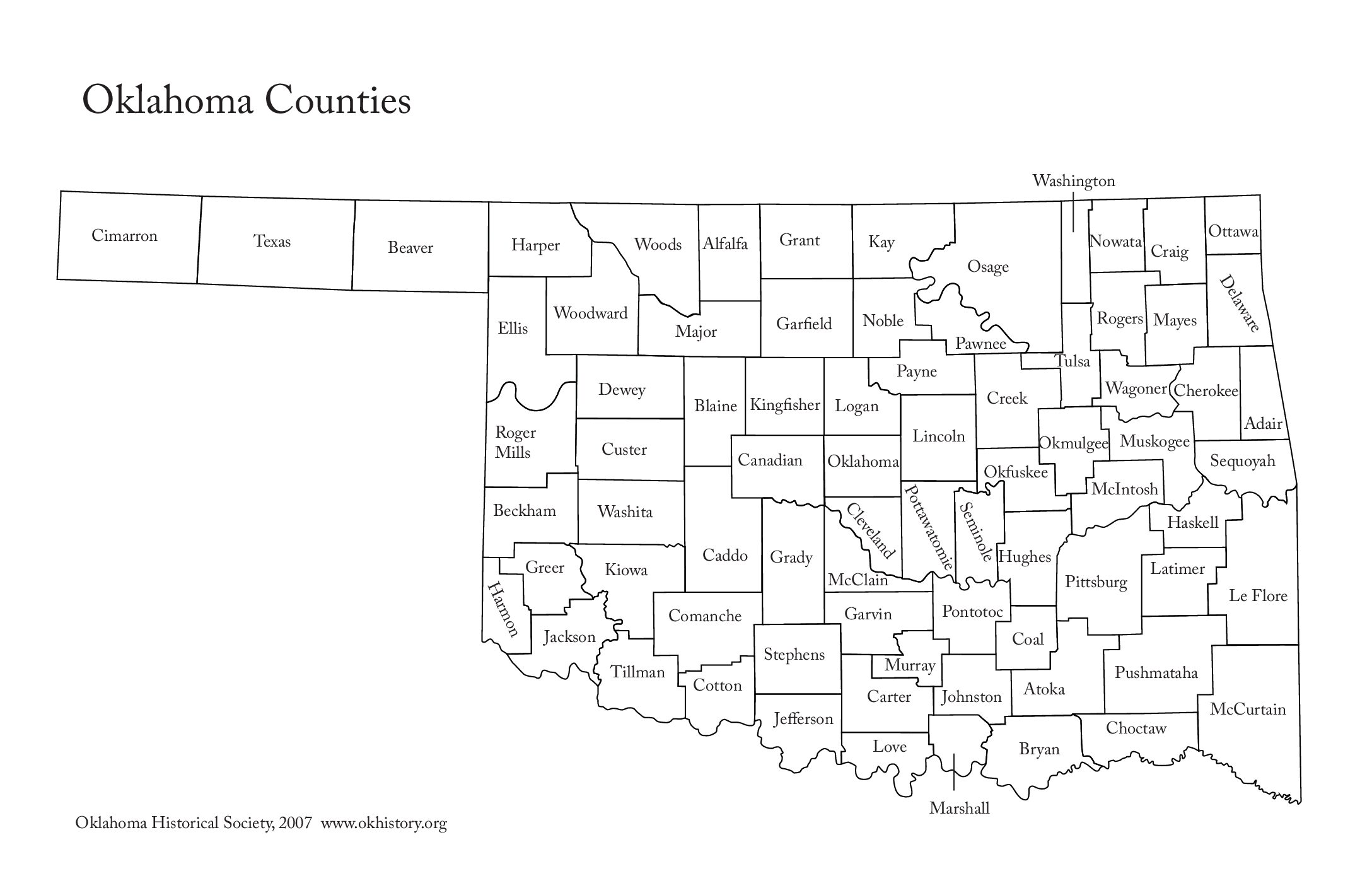
Each spring, Oklahomans can regularly be found listening to the radio or watching the television as weathermen and women report severe weather locations. Counties are typically used to identify storm locations, and while some names are easy to understand, others make us wonder.
While Oklahoma is ranked twentieth in size, it is seventeenth in the number of counties with 77. When it was first organized as the Oklahoma Territory, it had seven, which were designated numerically. When additional counties were added, they were given letters of the alphabet. When Oklahoma became a state in 1907, all the counties were renamed, with only two additional counties being added after statehood.
Oklahoma has 13 counties named for Indian tribes, and well-known Indian families have provided names for eight other counties. Six counties are named for U.S. Presidents, while rivers provided names for four counties. Military officers and Indian leaders are also honored.
Read on to learn what we found out about the etymology of our state’s counties.
Adair County was specifically named for Watt Adair, one of the first Cherokees to settle in the area.
Alfalfa County was formed at statehood as Woods County. The county is named after William H. “Alfalfa Bill” Murray, the president of the Oklahoma Constitutional Convention and ninth governor of Oklahoma.
Atoka County honors a Choctaw Chief named Atoka.
Beaver County was given because of the presence of many beaver dams on the Beaver River, which runs through the area.
Beckham County was named for J. C. W. Beckham, who was Governor of Kentucky and the first elected member of the U.S. Senate.
Blaine County is the birthplace of voice actor Clarence Nash, the voice of Disney’s Donald Duck. It is named for James Blaine, the Secretary of State under President Harrison.
Bryan County was named for Democratic politician William Jennings Bryan.
Caddo County was named for the Caddo tribe who were settled here on a reservation in the 1870s.
Canadian County in the central part of the state is named for the Canadian River.
Carter County was named for Captain Ben W. Carter, a Cherokee who lived among the Chickasaw.
Cherokee County is named for the Cherokee Indian Nation.
Choctaw County’s name is derived from Chahta, the mythical founder of the Choctaw people.
The westernmost county in the state, Cimarron County contains the only community in the state that observes the Mountain Time Zone and is named for the Cimarron River.
Cleveland County was named after U.S. President Grover Cleveland.
Coal County was named for the mineral that was then the major product of the region.
Comanche County was named for the Comanche tribe.
At statehood, the area which is now Cotton County fell within the boundaries of Comanche County. It split off in 1912, becoming the last county created in the state; it was named for the county’s primary crop.
Craig County was named for Granville Craig, a prominent Cherokee farmer who lived in the Bluejacket area.
Creek County got its name from the Creek Nation, whose country following Indian removal included the county.
Custer County was named in honor of General George Armstrong Custer.
Delaware County was named for the Delaware Indians who had established a village in the area prior to the arrival of the Cherokees in Indian Territory in the 1830s.
Originally created in 1891 as “County D,” voters in an 1898 election chose the name Dewey County, honoring Admiral George Dewey.
Ellis County was named for Albert H. Ellis, vice president of the 1906 Constitutional Convention.
Garfield County was named after President James Garfield. Prior to the Land Run of 1893, Garfield County was named O County.
Garvin County was named for Samuel J. Garvin, a local Chickasaw rancher, merchant and banker.
Grady County was named for Henry W. Grady, an editor of the Atlanta Constitution and southern orator.
Grant County was named County L in Oklahoma Territory at the time of its opening to non-Indian settlement. A county election renamed it for U.S. President Ulysses S. Grant.
Greer County is named for Texas stateman and Lieutenant Governor of Texas John Greer.
Harmon County takes is name for Judson Harmon, governor of Ohio and U.S. Secretary of State.
Harper County was created from the northwestern part of Woodward County and named for Oscar Green Harper, who was clerk of the Oklahoma Constitutional Convention.
Haskell County is named in honor of Charles N. Haskell, who was the first governor of Oklahoma.
Hughes County was named for W. C. Hughes, an Oklahoma City lawyer who was a member of the Oklahoma Constitutional Convention.
It’s unknown which Jackson Jackson County was named for: President Andrew Jackson or Confederate General Stonewall Jackson.
Jefferson County was created at statehood and named in honor of President Thomas Jefferson.
Johnston County was named for Douglas H. Johnston, a governor of the Chickasaw Nation.
Kay County was originally designated as county “K.” Kay County is the only county to keep its same name as the Oklahoma area moved from a territory to a state.
Kingfisher County was formed in 1890 and named Kingfisher by a vote of residents.
Kiowa County was named for the Kiowa people.
Latimer County was created at statehood and named for James Latimer, a delegate to the state Constitutional Convention.
Le Flore County honors a Choctaw family of French descent named LeFlore.
Lincoln County was named for Abraham Lincoln, the sixteenth president of the United States.
Logan County was named for John Logan, Federal general in the War Between the States, and a U.S. Senator from Illinois.
Love County was named for Overton Love, a prominent Chickasaw farmer, entrepreneur and politician. His descendants built the nationwide Love’s Travel Stops.
Major County was named for John Major, a member of the Oklahoma Constitutional Convention.
Marshall County was named to honor the maiden name of the mother of George Henshaw, a member of the Oklahoma Constitutional Convention.
Mayes County took its name for Samuel Houston Mayes, a teenage Confederate cavalryman, and mixed-blood Principal Chief of the Cherokee Nation.
McClain County pays homage to Charles M. McClain, an Oklahoma constitutional convention attendee.
McCurtain County was named for an influential Choctaw family that lived in the area.
McIntosh County is named for an influential Muscogee Creek family whose members led the migration of the Lower Towns to Indian Territory and served as leaders for generations.
Murray County was named for William H. Murray, president of the Oklahoma Constitutional Convention and later a Governor of Oklahoma.
Muskogee County was named for the Muscogee (Creek) Nation. The official spelling of the name was later changed to Muskogee.
Originally designated as County P, Noble County was renamed for John Willock Noble, then the United States Secretary of the Interior.
Nowata County’s nameis derived from a Delaware word “no-we-ata,” meaning “come here” or “welcome.”
Okfuskee County is named for a former Muscogee town in Alabama, from which the Creek were removed to Indian Territory, that in turn was named for the Okfuskee, a Muscogee tribe.
Oklahoma County is one of seven counties in the United States to share the same name as the state it is located in (the other six counties are Arkansas County, Hawaii County, Idaho County, Iowa County, New York County, and Utah County), and the only one of the seven to contain the state capital.
Okmulgee County is named after a Creek town of the same name in Alabama, from which the Creek were removed to Indian Territory. The name Okmulgee is derived from the word okimulgi, meaning “boiling waters.
Osage County is the largest county by area in the state and is named for and is home to the federally recognized Osage Nation.
Ottawa County was named for the Ottawa Tribe of Oklahoma.
Pawnee County is named for the Pawnee tribe, which settled in the area following the War Between the States.
Payne County was named for Capt. David L. Payne, a leader of the “Boomers.”
Pittsburg County got its name because county leaders believed that its coal production compared favorably with Pittsburgh, Pennsylvania, at the time of statehood.
Pontotoc County was named for an historic Chickasaw tribal area in Mississippi.
Pottawatomie County got its name for the tribe that lived in the area. It’s name is a Chippewa term that means “people of the place of the fire.”
Pushmataha County was named for Pushmataha, an important Choctaw chief in the American Southeast.
Roger Mills County got its name for Confederate office and U.S. senator from Texas.
The area of Rogers County was named the Cooweescoowee District at the time of statehood, but the residents protested. It was renamed for Clem Vann Rogers, a prominent Cherokee rancher and father of Will Rogers.
Seminole County is named for the Seminole Nation, whose capital is also the county seat of Wewoka.
Sequoyah County was named to honor legendary statesman and creator of the Cherokee syllabary, which brought literacy to the Cherokee Nation.
Stephens County was named for Texas politician John Hall Stephens, who championed for Oklahoma statehood.
Texas County was named for its neighbor to the south.
Tillman County was named for U.S. Senator Benjamin Tillman of South Carolina.
Tulsa County was named after the previously established city of Tulsa and the Creek village of Tulsey Town in Alabama.
Wagoner County is named for the county seat of the same name, which derived from Henry “Big Foot” Parsons.
Named for President George Washington, Washington County is the second smallest county in Oklahoma.
Washita County is named for the almost 300-mile long river that runs through it and empties into Lake Texoma and the Red River.
Woods County was named after Samuel Newitt Wood, a renowned Kansas activist, legislator, and newspaper publisher.
Woodward County was originally known as “N” County and was composed of present-day Woodward County and portions of Harper, Ellis, and Woods County. It is unknown exactly whom the county (and the town) is named after, but the two leading candidates are Brinton W. Woodward, a Santa Fe railway director, or Richard Woodward, a buffalo hunter.



-
 Country Lifestyle2 years ago
July 2017 Profile: J.W. Hart
-
 Farm & Ranch2 years ago
From Plow to Plentiful: The Most Important Inventions in Agricultural History
-
 Attractions9 years ago
48 Hours in Atoka Remembered
-
 Equine9 years ago
Umbilical Hernia
-
 Country Lifestyle5 years ago
The Two Sides of Colten Jesse
-
 Outdoors9 years ago
Grazing Oklahoma: Honey Locust
-
 Farm & Ranch8 years ago
Hackberry (Celtis spp.)
-
Attractions3 months ago
Oklahoma Ghost Towns – Navajoe