
Equine
Perception is Everything

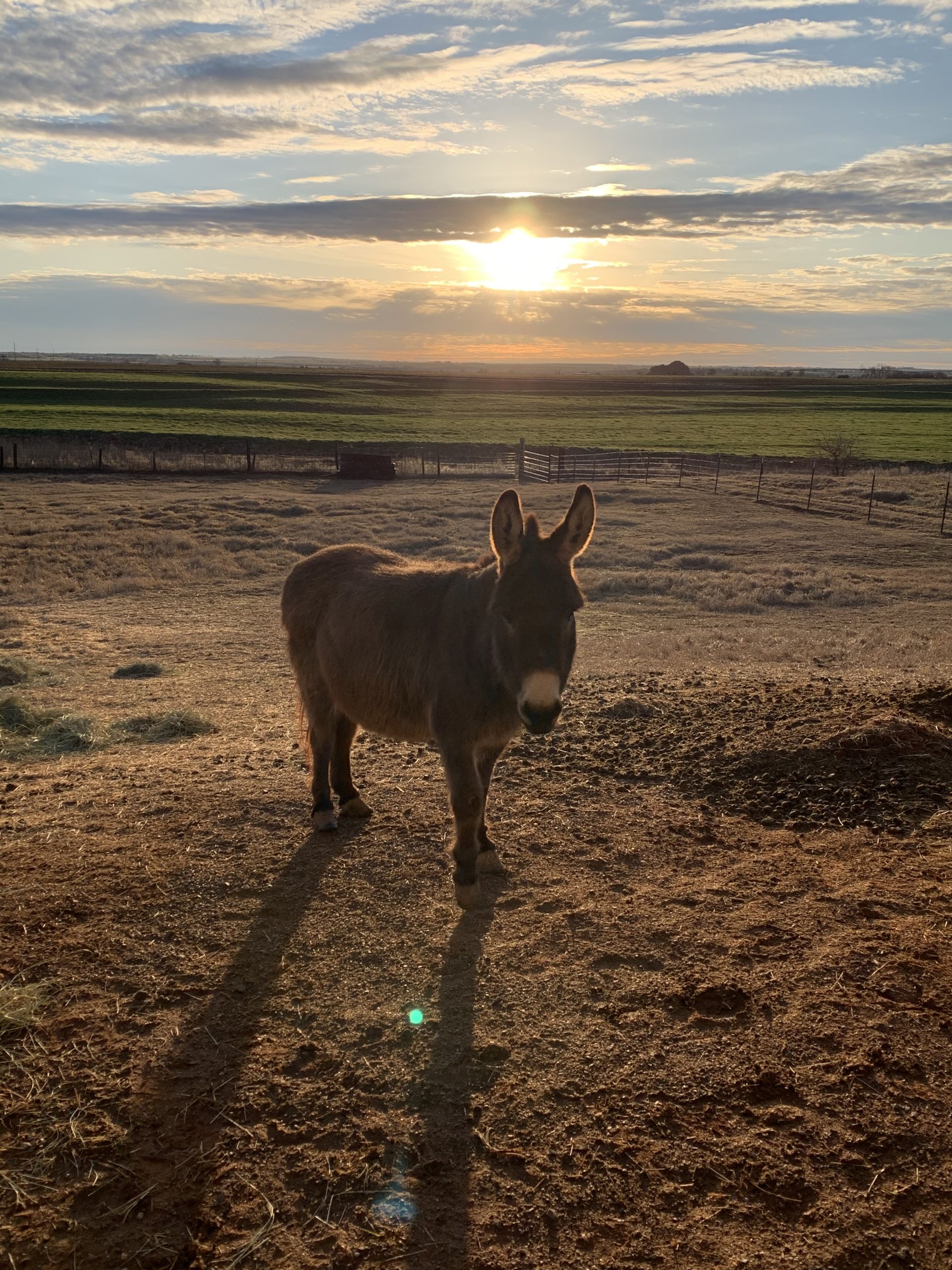
As I headed out the door to the barn, I saw him. He was standing quietly at the opening of the barn gazing off into the distance. He looked so peaceful and proud standing there with the sun behind his back. The setting sun was casting his shadow out in front of him. The shadow was long and majestic, and it appeared as if he was lost in thought looking at his silhouette.
As I stood quietly watching him, he seemed to sense my presence and turned quickly. For a split second our eyes locked and we shared a moment. Then he noticed the feed buckets I was carrying. The moment was lost, and the silence replaced by a loud bray as he came running towards me ready for his supper. The long silhouette vanished, replaced by my short, fat, long eared, carefree, gentle mini donkey “Billy”. In my heart of hearts, I truly believe the shadow is how Billy sees himself, majestic, brave and perfect, just like God sees us.
In a world full of “self -image” it is so easy to get caught up in how others see or perceive us. As a woman and a mother of two beautiful daughters, I understand completely we all want to look good, feel good, have the perfect outfit, good hair, etc. However, when we let our “outside” appearance define our self –worth, it is easy to lose our true self and forget the person inside.
This idea of self-worth vs. self-esteem has been heavy on my heart. How we see ourselves verses how others see us. So, what is the difference between self-esteem and self-worth? The key difference between self-esteem and self-worth is self-esteem refers to the appreciation the individual has for his or her abilities. Self-esteem boosts his or her confidence making a person feel they can do various tasks. On the other hand, self-worth can be defined as the value an individual gives to their self.
Whether it be the rodeo arena or the arena of life, there is a fine line between self-worth and self-esteem. When we are winning or on top of the world, it is very easy for both self-worth and self-esteem to be at an all-time high, but when our world is hectic, things aren’t going our way and it seems no matter what we do we cannot win, that is when the bottom falls out of both self-esteem and self-worth.
As a rodeo mom, I have watched not only my daughters, but other rodeo athletes struggle with self- worth and self-esteem when they are not winning. I feel the mental game of rodeo is the toughest and most struggled with obstacle. A rodeo athlete can be mounted on the best horse, have spent hours upon hours in the practice pen fine tuning their skills and their horses to be totally prepared for their event. Yet, when they ride into the arena or climb down into the chute, a rodeo athlete has less than 30 seconds from start to finish to put it all together. There are so many variables to be considered, such as the ground in the arena, the animals drawn that the competitors must either ride, rope or tie. Regardless of all the variables, it is still up to the rodeo athlete to make the best of the situation.
Having gone through losing streaks in life, I can testify losing streaks are like winning streaks; neither will last forever. However, riding the losing streak is a much harder ride. The devil of self-esteem and self-worth tends to step up and take the reins. It is important to focus on how we perceive ourselves. Do we feel worthy and what does our reflection in the mirror say to us? A positive attitude along with knowing you are worthy, in my opinion, are the most lethal weapons available to fight off the devil and take back the reins.
When times are tough, I remind myself when it is hardest to pray and praise, that is when I need to pray and praise the most. Do not let a win or a loss define your “true” self- worth. Simply put, do not let a winning streak give you too much self-worth and self-esteem as it can all fall apart in less than 30 seconds. In the words of Tim McGraw, “always stay humble and kind.” Another great quote from my father is, “never get too big for your britches.”
In a nutshell, a true winner doesn’t quit when times are hard. A true winner gets back up and tries again, and again and again. To be a winner in life, surround yourself with people who clap for you when you win and tell you to get up when you fall, and do not forget to do the same.
Most importantly be like Billy; see yourself as a winner and always remember God sees all his children as majestic, brave and perfect, regardless, if we walk out of the arena with a gold buckle or a face full of dirt.
Until next time….
Read more great stories in the April 2020 issue of Oklahoma Farm & Ranch.
By Dr. Devan England DVM
Does your horse have gastric ulcers? Gastric or stomach ulcers are frequently blamed for a variety of things including poor performance, acting ‘cinchy’, weight loss, not eating, poor coat condition, diarrhea and colic. However, gastric ulcers are not always the culprit and the only way to know for sure if your horse has gastric ulcers is to look at the stomach on camera, using an endoscope. Poor appetite and poor body condition are the mostly widely observed clinical signs with gastric ulcers, however, these are non-specific. If you think your horse might have gastric ulcers, the best place to start is to talk to your veterinarian and consider scheduling a gastroscopy. Gastroscopy requires the horse be held off feed for at least 16-18 hours and held off water for at least 6-8 hours. Fasting off feed and water is necessary to allow the veterinarian to see the whole stomach. If restricting feed or water is difficult in your management situation, many veterinarians will allow you to hospitalize your horse the night before gastroscopy for proper fasting.
Gastric ulcers are split into two types, classified by the location of the ulcer in the stomach. Squamous ulcers are ulcers that occur in the squamous or skin like portion of the stomach. This is the top part of the horse’s stomach, is closest to the esophagus, and has squamous tissue to protect this portion of the stomach from stomach acids. The other ulcer type are glandular ulcers. Glandular ulcers occur in the bottom portion of the stomach, which is closest to the small intestine. This portion of the stomach has glandular mucosa with cells responsible for producing stomach acids for digestion as well as cells that produce mucus and buffers to protect the lining from stomach acid. Gastroscopy is important not only for diagnosing whether ulcers are present but also determining the severity and the type of ulcer, because these two ulcer types require different treatments.
Squamous gastric ulcers are common in racehorses both in and out of training, with higher prevalence in racehorses under training. Prevalence in Thoroughbred racehorses in training has been reported to be up to 100% (Sykes 2015). Squamous ulcers are also prevalent in Western pleasure horses, Thoroughbred stallions on breeding farms, and Italian donkeys (Sykes 2015). Glandular gastric ulcer prevalence has not been as well described as squamous ulcers. Glandular ulcers are reported to be most common in Thoroughbred and Standardbred racehorses, Canadian showjumpers and polo ponies, and American Quarter Horses (Sykes 2015).
Risk factors for ulcers vary by ulcer type. Anti-inflammatories (Bute, Banamine) can increase the risk of glandular ulcers in some horses by affecting normal defense mechanisms but are not a high risk in most horses. Horses that display stereotypic behaviors, such as cribbing, have an increased risk of squamous ulcers. Grain fed before hay in non-exercising horses, feeding larger amounts of grain, and increased time between meals increases the risk of squamous ulcers. Increased time with high intensity exercise and housing in single pens is associated with increased risk of glandular ulcers. A straw only diet, lack of water access and lack of direct contact with other horses increases the general risk of gastric ulcers.
If your horse is diagnosed with ulcers, the mainstay of treatment is a buffered formulation of omeprazole (Gastrogard, Ulcergard). Over the counter Omeprazole and compounded Omeprazole are not effective because without buffering, the acidic stomach quickly breaks down the drug before absorption. Most horses with squamous ulcers will have healing of these ulcers after a 4-week course of Gastrogard or Ulcergard at treatment dose (whole tube for the average horse). Some horses may be healed by 3 weeks of treatment, but all horses should undergo a recheck gastroscopy before stopping treatment. Horses diagnosed with glandular ulcers need combination therapy with Gastrogard/Ulcergard and Sucralfate for 4 weeks. About 2/3 of horses with glandular ulcers will heal in this time, but some horses may require longer treatment times so a recheck is always recommended before discontinuing treatment.
Horses at higher risk of gastric ulcers may benefit from preventative (low) doses of Ulcergard (1/4 tube in average sized horse) given for a few days before and during high stress situations like long distance travel and competitions. Sea buckthorn berry supplement may be protective against formation of glandular ulcers. Dietary management to decrease the risk of ulcers includes providing more frequent small hay meals if pasture access is not available, limiting high sugar grains as much as possible and adding vegetable oil to the feed.
Sykes BW, Hewetson M, Hepburn RJ, Luthersson N, Tamzali Y. European college of equine internal medicine consensus statement – equine gastric ulcer syndrome in adult horses. J Vet Internal Med 2015; 29:1288-1299.
By the time the June issue reaches readers, the regular breeding season is winding down for many horse owners. Some mares are already confirmed in foal, some breeding decisions have been pushed aside for another year and some owners are already thinking ahead to next season. For those with an older mare they hope to breed, that early planning can make a real difference.
Older mares can still produce foals, but they may need more help than younger mares. Age affects the reproductive system, and those changes can make it harder for a mare to become pregnant, stay pregnant or carry a healthy foal to term. That does not mean every older mare is a poor candidate for breeding. It does mean owners should go into the process with realistic expectations and a good veterinarian involved from the beginning.
A mare’s reproductive age does not always match her number of birthdays. Some mares in their mid-to-late teens settle easily and carry foals without much trouble. Others begin having problems earlier. Past reproductive history matters. A mare that has had regular foals may be different from an older maiden mare that spent most of her life showing, racing, working or sitting open. Health, body condition, uterine health and conformation all play a role.
One of the main challenges with older mares is egg quality. As mares age, their eggs age, too. Older eggs are more likely to have abnormalities that prevent fertilization, stop early embryo development or lead to early pregnancy loss. Even when breeding is timed well and the stallion has good fertility, the mare may not settle because the egg itself is no longer as viable as it once was.
The uterus also changes with age. The lining of the uterus, called the endometrium, can become less healthy and less able to support pregnancy. Over time, some mares develop fibrosis or scarring within the uterus. This can interfere with the placenta’s ability to develop and support a growing fetus. A mare may get pregnant early, but then lose the pregnancy because the uterus cannot maintain it.
Older maiden mares can face an additional problem. When a mare cycles, it is normal for some fluid to be present in the uterus. A healthy reproductive tract clears that fluid through uterine contractions and cervical relaxation. In some older mares, especially those that have never had a foal, the cervix may not relax well enough. Fluid can build up and remain in the uterus after breeding. That fluid can damage sperm, interfere with an embryo and increase the risk of infection or inflammation.
Post-breeding inflammation is another concern. All mares experience some uterine inflammation after breeding, but most clear it within a reasonable amount of time. Older mares may not clear it well. This can leave the uterus in a poor environment for pregnancy. A veterinarian may recommend uterine lavage, medication or other treatment after breeding to help the mare clear fluid and inflammation.
External conformation can also affect fertility. As some mares age, especially taller, thinner mares or mares that have had multiple foals, the reproductive tract may tilt in a way that allows manure or air to contaminate the vulva and vagina. Poor vulvar conformation can increase the risk of uterine infection. In some cases, a veterinarian may recommend a Caslick’s procedure to help protect the reproductive tract.
Because so many factors can be involved, an older mare should have a breeding soundness exam before the next season begins. This may include a physical exam, reproductive ultrasound, uterine culture, cytology and possibly a uterine biopsy. These tools help determine whether the mare has infection, inflammation, fluid retention, poor uterine health or other issues that need to be addressed before breeding.
Timing is also important. With an older mare, it is usually better to start early in the season rather than waiting until late. More cycles give the veterinarian more chances to manage the mare properly. Early planning also allows time to treat infection, improve body condition, schedule semen shipments, evaluate the stallion’s fertility and consider whether cooled semen, frozen semen, live cover or another option makes the most sense.
Owners should also look closely at the mare’s overall health. A mare that is too thin, too heavy, metabolically unstable, lame or dealing with chronic illness may struggle to conceive or carry a foal. Good nutrition, dental care, hoof care and vaccination planning all matter. Breeding may be a reproductive decision, but pregnancy affects the whole horse.
For some mares, advanced reproductive options may be worth discussing. Embryo transfer allows a valuable mare to produce a foal without carrying it herself. This may be helpful for older mares that can produce an embryo but should not carry a pregnancy, or for mares that are still competing. Other assisted reproductive techniques may also be available through specialized equine reproduction centers.
The hard truth is that breeding an older mare can take more time, money and patience. Not every mare will get in foal, even with good care. Some mares should not be bred if the risks are too high. Still, many older mares can produce healthy foals when problems are identified early and managed correctly.
For owners hoping to raise one more foal from a favorite mare, the best plan is to start the conversation before breeding season arrives. Talk with a veterinarian, evaluate the mare honestly and make decisions based on her health, history and reproductive exam. Hope is part of breeding horses, but planning gives that hope a much better chance.
By Summer McMillen
Everyone that knows anything about horses knows that there are bad ones, good ones, and great ones.
The bad ones are good for nothing. You can’t catch them, you can’t saddle them, and you can’t get on them without feeling like you need a helmet, some kind of padded vest and, an instruction manual. Once you do mount up the whole ride is a battle and heaven forbid, you actually have a job to do because they are little to no help in holding the herd. We all find ourselves owning a bad one or two throughout our lives. Best case scenario is they find a more tolerable home to go to through via a horse sale or the classifieds. Worst case scenario all you can do is say “Vaya con Dios,” put a sign on them that reads “Do Not Attempt,” and turn them out to pasture. Hoping they are decent enough to stay within the borders and make a beautiful yard ornament.
Good horses are usually much more tolerable. They’re pretty easy to catch, saddle, and hop up on. Sometimes they might have a bad habit or two like setting back when they’re tied to a fence or, getting cold backed on early mornings that you tolerate because they are so skilled in a specific field. A good horse is usually only good for one thing. They have a niche talent m, if you will. They can be a good heel horse. A good head horse. The horse you want to gather pastures on because you know he won’t knicker or rare up when you get dropped off in the jig line. A good kid horse. Your rodeo horse. The horse you put your wife on when she’s being a little wimpy that day. Good horses usually get sold because they are proficient in their given field and they find good homes making both parties happy. We will all own many good horses in our lives and be happy to do so.
Great horses are a rare and treasured possession. They are simultaneously easy and hard to own. Easy because you can do anything on them. Hard because everyone is always trying to buy them from you. A great horse stands still while your kid pulls their head down all the way to the ground so they can halter them. A great horse is never cold backed and always ready to cinch tight and take off. A great horse can be ridden in the pasture and the rodeo arena on the same day. A great horse doesn’t need practice. A great horse is always willing to do anything you ask of them at any given moment. Great horses find their homes as horse colts and usually live out the rest of their days at the same home because great horses are irreplaceable.
People and horses are not all that different. There are bad, good, and great ones. The more time I spend around horses the more I am convinced of the kind of person I want to be. “Bad” will absolutely not do. “Good“ is much too common and just doesn’t quite cut it more often than not. “Great” is what I aspire to be.
Great can be defined in so many ways when we let human standards get involved but, I want to be great as defined in the qualities of a great horses.
I want to be kind and patient while my children are learning. I want to be ready to help anyone who asks me. I want to go the extra mile. I want to make my home a beautiful place to come to after a full day’s work outside. I want to not be thrown off by life’s twists and turns but, firm in my faith.
So, basically what I’m saying is I want to be a great horse. And honestly there are worse things we could all aspire to be.
Here’s to great horses. May we know them, love them, and if we’re lucky be great just like them.





-
 Country Lifestyle2 years ago
July 2017 Profile: J.W. Hart
-
 Attractions9 years ago
48 Hours in Atoka Remembered
-
 Farm & Ranch2 years ago
From Plow to Plentiful: The Most Important Inventions in Agricultural History
-
 Equine9 years ago
Umbilical Hernia
-
 Outdoors8 years ago
Grazing Oklahoma: Honey Locust
-
 Country Lifestyle5 years ago
The Two Sides of Colten Jesse
-
 Farm & Ranch8 years ago
Hackberry (Celtis spp.)
-
 Equine6 years ago
On the Road with Emily Miller-Beisel