
Equine
When a Nosebleed in Your Horse Means Business

It usually starts the same way. You walk into the barn, or pull your horse up after a hard run, and notice a streak of red sliding from one nostril. For most horse owners, that sight alone is enough to make your stomach drop. Nosebleeds in horses — known medically as epistaxis — can be anything from a harmless trickle to a serious medical emergency. The trick is knowing the difference.
Understanding What’s Really Going On
“Epistaxis” simply means bleeding from the nostrils. It can look dramatic, especially on a horse’s light-colored muzzle, but not every case is cause for panic. The real question is where the blood is coming from and why it started. Horses can bleed from several different parts of their upper and lower respiratory systems, ranging from the delicate nasal passages at the tip of the nose to deep within the lungs
External signs don’t always tell the full story. A steady stream of blood might come from a relatively minor nasal scrape, while a single drop could signal a deeper issue if it occurs repeatedly. Because of that, determining the origin of the bleed often requires a veterinarian’s examination and, in some cases, diagnostic tools like endoscopy or radiographs.
Still, horse owners can gather useful clues before the vet arrives. What was your horse doing just before the nosebleed began? Did it happen after intense exercise or while the horse was standing quietly in the stall? Is blood coming from one nostril or both? Has this happened before — and if so, always from the same side? Observations like these help narrow down the list of possible causes.
If blood is merely dripping or running slowly, chances are you’re not dealing with an immediate emergency. But if it’s flowing freely — more like a faucet than a leak — or doesn’t stop within a few minutes, it’s time to call your veterinarian.
Common Causes of Equine Nosebleeds
The list of potential sources for a horse’s nosebleed is long, but they generally fall into a few categories.
One of the most common and least serious is nasal mucosal trauma — a simple scrape or irritation of the tissues lining the nasal passage. Horses are curious creatures and not always careful about what they bump into. A playful nose rub on a rough fence board or an overly enthusiastic sneeze can rupture a tiny blood vessel and cause a short-lived trickle of blood. Passing a nasogastric tube or removing a foreign body can also irritate the area temporarily.
A more persistent cause is progressive ethmoid hematoma, a vascular mass that forms within the nasal cavity or sinuses. These growths often bleed intermittently and almost always from the same nostril. The bleeding is usually modest but tends to recur over time. While the initial episodes may not look alarming, the mass will continue to grow if untreated, so early veterinary intervention gives the best chance of successful removal.
Another possibility involves the sinuses themselves. Trauma, infection, or even small fractures to the skull can lead to bleeding within the sinus cavities. Horses are notorious for finding new and inventive ways to injure themselves — banging into doors, slipping in the trailer, or catching a halter just wrong — and sometimes the only outward sign is a slow bleed from the nose. Small fractures often heal with rest, but significant ones may require surgical repair.
Bleeding from both nostrils usually suggests a deeper origin. One of the best-known examples is Exercise-Induced Pulmonary Hemorrhage (EIPH), sometimes called “bleeding” in racehorses. This occurs when capillaries within the lungs rupture under the extreme pressure of intense exercise, sending blood up through the trachea and out both nostrils. Horses affected by EIPH might cough, swallow repeatedly, or show decreased performance after a run. Though it’s most common in racehorses, it can appear in any equine athlete pushed to their limits.
The most dangerous cause of all is guttural pouch mycosis, a fungal infection of the guttural pouches — air-filled sacs located behind the horse’s skull that connect to major arteries. The fungus, often Aspergillus fumigatus, thrives in warm, dark, and moist environments such as hay and soil. As it grows, it erodes the arterial walls, sometimes silently, until a vessel ruptures and the horse begins to bleed heavily from the nose. In some cases, this can lead to fatal blood loss within minutes. If a horse shows even minor, unexplained nosebleeds that repeat from the same side, it’s worth scheduling an endoscopic exam to rule this out.
When It’s Time to Act
It’s not always easy to tell which kind of nosebleed you’re dealing with, but the following general rule applies: the more rapid and continuous the bleeding, the more urgent the situation. If the blood is coming in spurts, pooling quickly, or refuses to stop, treat it as an emergency. A horse can lose a significant amount of blood in a short period, especially if a major artery is involved.
On the other hand, a small amount of blood that stops on its own and doesn’t return likely points to a minor issue. Even so, it’s smart to keep notes — which nostril bled, how long it lasted, what the horse was doing, and any other symptoms you noticed. This information can help your veterinarian determine whether further testing is necessary.
If your horse experiences recurring nosebleeds, particularly from the same side, don’t ignore them. Repetition can be the biggest red flag of all.
When you call your vet, expect a methodical evaluation. They’ll first perform a physical exam and may use an endoscope, a flexible camera designed to navigate the nasal passages and visualize the sinuses, guttural pouches, and upper airway. Endoscopy allows the veterinarian to identify the exact source of bleeding — whether a scraped mucosa, a growing hematoma, or a fungal lesion.
If there’s evidence of trauma, radiographs may be taken to assess bone integrity. Horses with suspected guttural pouch infections or ethmoid hematomas often undergo additional imaging or even surgical procedures to address the underlying issue. For suspected EIPH, an endoscopic exam performed within an hour or two after exercise can confirm blood in the trachea and lungs.
While you’re waiting for the veterinarian, keep your horse calm and still. Excitement or movement can raise blood pressure and worsen bleeding. Remove tack, halter, or anything that might interfere with breathing. Resist the urge to pack or plug the nostrils — this can cause more harm than good. Instead, observe closely and document what you see. If safe to do so, a quick photo or short video can be helpful for your vet later.
Do not tilt the horse’s head upward, as that can allow blood to flow backward into the airway. Let the horse lower its head naturally. Fresh air and a quiet space are best until professional help arrives.
A horse’s nosebleed can stop your heart for a moment, but it doesn’t always mean disaster. Many are brief and harmless, the result of a bump or sneeze in just the wrong way. But others — particularly those that are heavy, prolonged, or recurring — can point to serious underlying disease.
When in doubt, treat every nosebleed as something that deserves attention. Take a deep breath, make careful observations, and get your veterinarian involved early. In the long run, those few extra minutes of vigilance can make all the difference.
References
“Equine Epistaxis: What You Need to Know.” The Horse, American Association of Equine Practitioners.
“Exercise-Induced Pulmonary Hemorrhage in Horses.” Merck Veterinary Manual.
“Nosebleeds in Horses — When Do You Need to Be Concerned?” Horse & Hound.
“Epistaxis (Nosebleed) in Horses.” PetMD.
“Nasal Hemorrhage in the Horse: Where and Why.” DVM360 Proceedings.
By Ann Asher
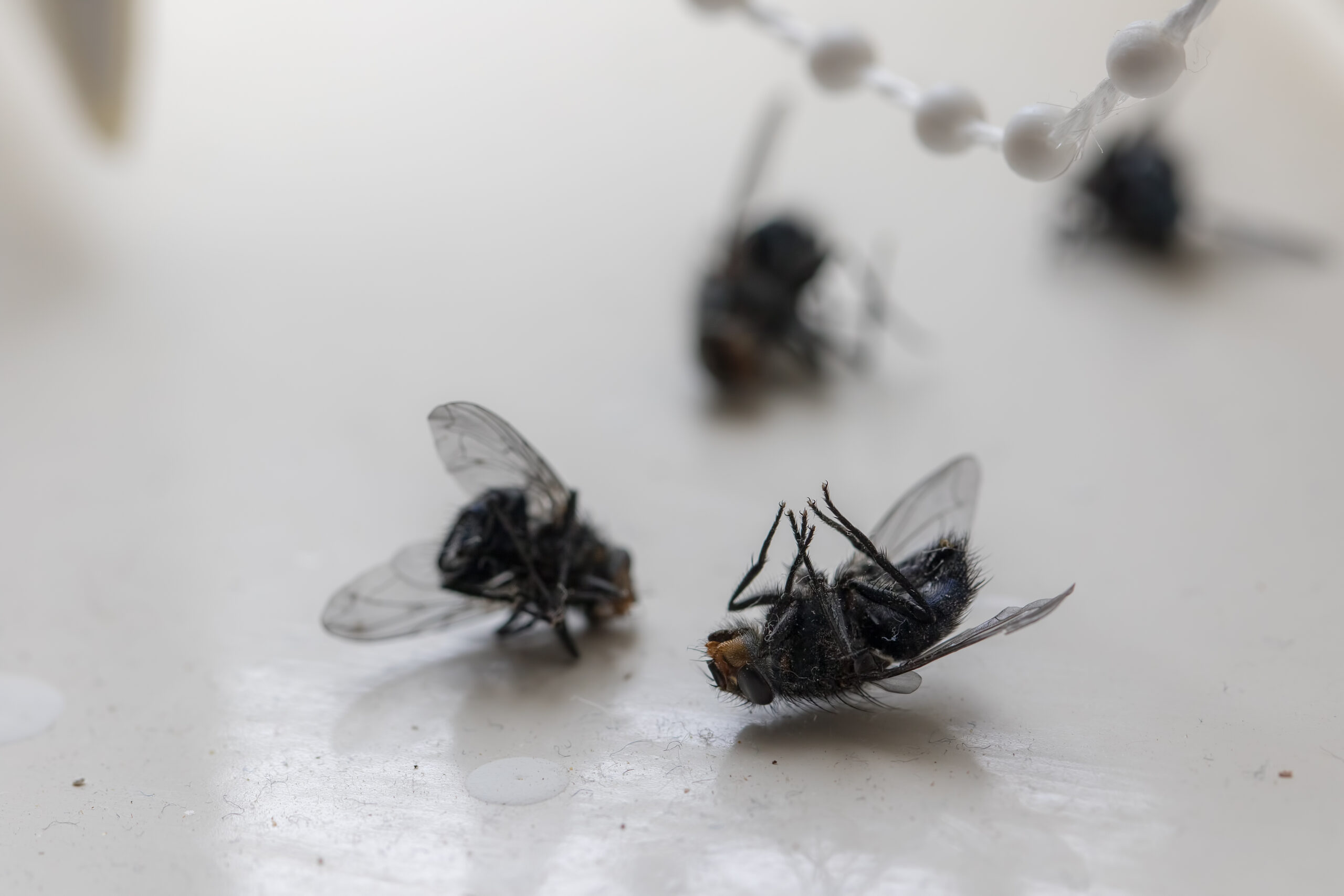
Every year about this time, it feels like the flies start winning. No matter how clean I keep the pens or how many fly strips I hang, they show up in clouds. Over the past few summers, I’ve tried just about everything—feed-through supplements, predator bugs, DIY traps, and plenty of fly sprays. Some things helped. Some were a waste of money. If you’re battling flies this year, here’s what’s actually worked for me—and what research says can make a real difference on the farm or ranch.
Start with Cleanliness (But Know It’s Not Enough)
The first—and most repeated—advice is to stay ahead of the mess. Manure management is critical, especially around barns, pens, and loafing sheds. Flies lay eggs in fresh manure, and those eggs hatch into larvae in as little as 24 hours during warm weather.
I try to clean high-traffic areas at least every other day, but the truth is, even on the cleanest farms, flies can still be a problem because of moisture, standing water, and nearby neighbors.
Feed-Through Fly Control: A Solid Foundation
One thing that made a noticeable difference for my horses and cattle was starting a feed-through larvicide early in the season. These products add a growth regulator to the feed that passes through the animal and prevents fly larvae from developing in manure.
It’s not an instant fix—you won’t see fewer flies for several weeks—but once it kicks in, you’ll notice fewer new flies being born.
Tip: Feed-through products only work if all animals on the property are eating it consistently. Otherwise, you’re just treating part of the manure, and flies will keep breeding.
Fly Predators: Small, Mighty, and Surprisingly Effective
Last year, I tried fly predators for the first time. These are tiny, non-stinging insects that lay their eggs in fly pupae, stopping the next generation.
I was skeptical (and honestly a little creeped out at first), but I noticed that where I used predators around the barn and dry lots, the fly pressure dropped. Some companies even offer subscription services that send predators timed to your local climate.
Tip: Fly predators don’t kill adult flies—they stop future flies. So you still need to control the adults already buzzing around.
Good Old-Fashioned Fly Traps
In areas like the barn aisle and outdoor runs, nothing beats physical traps.
I like a combination approach:
- Sticky ribbons and strips for indoor areas
- Odor-baited traps placed away from livestock areas to draw flies away
Tip: Hang baited traps a good distance from barns or stalls. Otherwise, you’re luring flies right into your animals’ space.
Fly Sprays: Choose Carefully
Fly sprays are the first thing most of us reach for—and they do help—but they have limits.
For horses, sprays containing pyrethrins, pyrethroids (like permethrin), or natural oils tend to offer the best repellency. Even then, most sprays only last a few hours, especially if animals are sweating heavily.
Tip: Apply before morning turnout and again before evening if possible. Reapplication is important, especially after heavy exercise or rain.
Other Tools That Help
- Fly masks and fly sheets — particularly those with UV protection, to protect sensitive areas like the eyes and ears
- Fans in barns and run-in sheds — flies struggle to land in strong airflow
- Automatic sprayer systems — an investment, but highly effective for larger barns
The bad news? There’s no magic bullet for fly control.
The good news? Combining several methods—manure management, feed-through treatments, predators, traps, and targeted sprays—can actually make summer bearable for you and your livestock.
At the end of the day, I figure if I can cut the fly population by half, I’ve already made life better for my animals—and a lot less miserable for myself.
References:
- Texas A&M AgriLife Extension – Managing Flies on Livestock
- University of Kentucky Entomology – Controlling Flies Around Livestock
- North Carolina State Extension – Livestock Pest Management
- USDA Agricultural Research Service – Fly Management Resources
- Spalding Labs (for info on biological control programs) – Fly Predators Information
By Laci Jones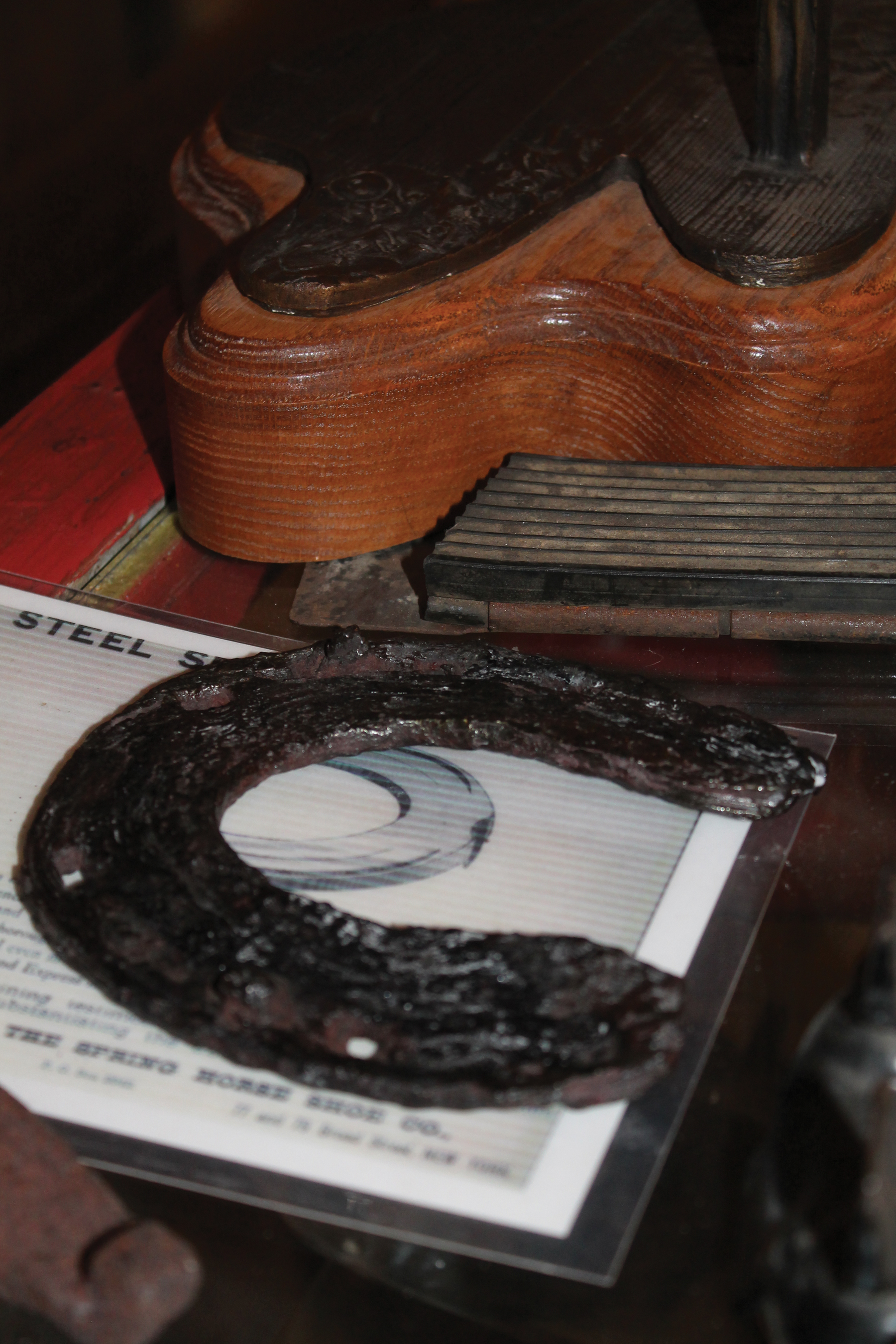
If it were not for the horseshoe and wagon wheel, the United States would not have been founded, according to Lee Liles. The owner of the National Museum of Horse Shoeing Tools and Hall of Honor said Oklahoma is the grandest example in the world.
Horseshoe books date back to 400 B.C. In fact, the oldest horseshoe at the museum in Sulphur, Okla., is more than 500 years old from Denmark.
“I don’t like going back much farther than 1860 because we don’t have the documentation to back it up,” Liles explained. “You got a few magazines like the Harper Weekly and the Wallaces’ Report, but you want to verify the facts.”
19th Century Patents
The first patent on a horseshoe manufacturing machine in the United States was issued in 1834 to Henry Burden, a Scottish-born industrial engineer. By 1850, Burden had more than 50 different patents on his machines at Burden Iron Works in Troy, N.Y., Liles added.
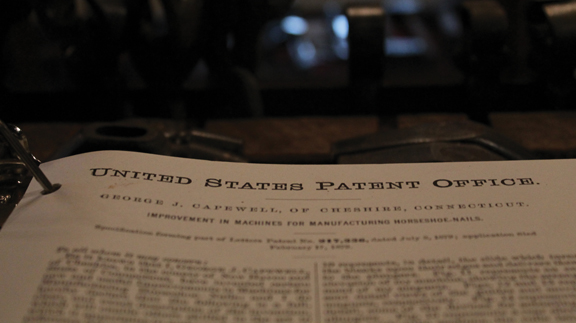
This was all before the first horseshoe nail patent, which was issued in 1863 to Daniel Dodge in Keeseville, N.Y. The horseshoe nail is the most difficult nail in history to manufacture, Liles explained.
“It’s got a lot of different tapers to it,” he explained. “The nail needs to be strong and durable enough to drive through a foot, come out, be turned over 180 degrees and clenched down in the horse’s foot.”
The nail industry has changed a lot throughout the years, Liles said. In 1853, the horseshoe nail was made from Swedish Iron, but copper nails have become popular in recent years. The oldest nail company left in the United States was the Capewell Horse Nail Company owned by the Mustad family. The nail company started in 1881, and they recently moved out of the country.
“All of these major shoe companies, tool companies and nail companies were located in the northeast United States,” he explained. “That’s where the population was. There weren’t any companies located down here in the South like Oklahoma or Texas.”
Horseshoeing Literature
Most information on horseshoeing actually came from Germany, Liles explained. German books were first written in 1861 by Leisring and Hardman. In 1882, Lungwitz was added as a co-writer.
“[Leisring, Hardman and Lungwitz] were the main vets at the Royal Veterinary College,” Liles said. “[Hardman] wrote his own first book in 1884 and wrote 24 editions. Nobody else has ever written that many books.”
Liles said books are the greatest assets for education. In 1866, the U.S. Congress adapted the cavalry books would be written on the Dunbar System.
“Alexander Dunbar was a person who our Federal Government paid to teach anatomy to horseshoers back in that era,” Liles explained.
John Kerman, who was running a horse shoeing school at Fort Carlisle, Penn., wrote the book written on the Dunbar System. The first American horseshoe book was written in 1871. In 1902, Kerman came to the shoeing school at Fort Riley, Kan.
“The cavalry has been the main source of horseshoers in this country up to the 1950s,” Liles said. “The Army technical manual, TM-220, has been the most copied horseshoeing book in history.”
In the 1890s, Pennsylvania State recruited Mississippi-native, John Adams as a professor. The university sent Adams to Germany to study under Lungwitz.
“When he came back in about 1896, he and Lungwitz were such good friends that he had permission to write the American edition of the Lungwitz book,” Liles explained. “When he came back, Adams brought an instructor from Germany to Penn State to teach anatomy and horseshoeing to the vet students.”
Even Cornell University and Michigan State University had a protégé of Lungwitz in 1913, Liles said.
William Russell
“We had a great educator in Cincinnati, Ohio, who wrote 15 horseshoeing books from 1879 to 1907,” Liles explained. “His name was William Russell.”
In 1887, the first shoemaking contest was held in Cincinnati, Ohio, where Russell won. “The contest consisted of making 100 shoes on an opry stage in front of 3,000 spectators,” Liles explained.
Russell made 100 horseshoes in two hours and 40 minutes with the help of a team. John Silk, who later became a famous horseshoer, was one of Russell’s competitors.
In the 1890s, many horseshoers, including Russell, created display cases filled with their horseshoes. Many of these display cases are still intact and hanging in the museum. One of the cases was in the World Fair in St. Louis in 1904.
“When it went to the World Fair, they added nails to the case,” he added. A photo of the case at the World Fair was added into one of Russell’s books, and it was one of the last display cases he made. Russell offered all of his collection for sale in the same year.
“He died in 1907,” Liles explained. “He was a sick man, and he was blind when he died.”
Aluminum Horseshoe
Liles also has a case located at the museum built in 1895 had an aluminum horseshoe inside. “That is very rare,” he said. “In that era, they only produced 65 pounds of aluminum per year. Aluminum was a precious metal, and you had to buy it through a jeweler.”
Liles said he does not think the aluminum held up well to wear and tear. William Wedekind received the title, “The World’s Greatest Horseshoer” at the 1892 Chicago World’s Fair. Wedekind even made an aluminum horseshoe in 1883.
“It was so light that it floated on water,” Liles explained. “They can’t duplicate the shoe today to make it float on the water.”
The Right Shoe
Liles said when people come to museum, they are used to dealing with one breed of horse and one discipline with the horse. The type of horseshoe used depends on the breed and the discipline. “In this country, we have roughly 400 different breeds of horses,” Liles said.
Liles said he was a horseshoer, which is a lot different from a cowboy shoer. For instance, a horse that is going to go trail riding or ranching needs a high-quality steel horseshoe.
A show horse will wear aluminum shoes because the aluminum will wear the toe quicker. “It will give him a quicker time to break that shoe in,” he added. “If your shoe isn’t new at the show, he has to get that shoe back to where it feels comfortable.”
Many of the plastic shoes are meant for horses that are on concrete, asphalt or wood. Liles said plastic shoes are commonly used in the circus.
A common misconception is people think the weight of the horseshoe affects a horse in either racing or working. “They think plastic is so much lighter,” he explained. “If that is the case, why don’t you just ride him barefoot?”
To learn more about the history of the horseshoe, visit www.horseshoeingmuseum.com.
This article was originally posted in the July 2016 issue of Oklahoma Farm & Ranch.
By Summer McMillen
As the land starts to thaw and cowboys and cowkids everywhere are gearing up for spring there is one specimen in particular that is dreading the coming season. And that is ponies. Or more specifically, kid horses.
Let’s look at life from the kid horses point of view for a second.they have the winter off. They’ve gotten to enjoy some much needed R&R in the back pasture. Their hair has gotten long and so have their hooves. They’ve spent the winter feasting on native grasses, alfalfa, and the occasional bucket of grain when it’s was especially cold.
They’ve gotten to wonder aimlessly while the real work horses were still being caught for essential tasks. The most work these kid horses have had to endure the last few months were being tied to the arena fence to get the cockleburs brushed out of their tail.
Yes, life has been calm for these kid horses. But, there is a season for everything and the season for being used and abused is fast approaching.
My own children all share a little pony they affectionately call “Rubble.” He is a certified welsh pony that is as tall as he is wide and is as passive as he is…not. They spend summers riding him bareback. And when they aren’t riding him bareback they are riding him fully saddled. Tiny little bit in his mouth being yanked in every which direction.
The little fellow takes everything in stride. But I can feel him starting to resent me from the back pasture already. Every time I carry him some feed he gives me a look that just screams “please keep all three of your children away from me forever please.” I laugh at him and tell him he doesn’t mean it and then he runs away as fast as he can. It’s a special bond.
Kid horses are funny like that. We entrust them with the lives of those most special to us. We saddle them up and throw the little cowkids on them and assign them small tasks like moving 200 pairs to a new pasture or, holding the herd while dad doctors wheat cattle. More often than not, the young partners get their job done. Sometimes in unlikely ways.
Last summer my daughter hopped up on Rubble bareback and was going to trot down the road and get our mail. A simple and harmless task I thought. I was proud of her for taking the initiative. I was also proud of her when I looked out the window, saw the little pony start crow hopping with excitement and the unassuming 8-year-old being catapulted in the ditch. Instead of crying she climbed back on. Tenacity, I thought. That’s what kid horses are good at teaching.
A few months later I was watering all our geldings. The three kids whom I raised, better known as the three amigos, were all harassing the little pony. My youngest son decided it was his turn. He climbed up on Rubbles back as proud as a peacock. But, he couldn’t help himself. He wanted to look that pony in the eye. So he starts leaning. Farther and farther until he leaned all the way to the ground. Lost a boot in the process. Instead of rushing to his side I waited for the tears. He was only two years old at the time after all. Instead his face was filled with glee. Joy, I thought. That’s what kid horses are good at teaching.
My middle boy is afraid of heights. So mounting a horse has been tough for him. When we introduced Rubble, I wasn’t sure he could even manage his height. After a little encouragement he donned his chaps, boots, and hat with a turkey feather in it and mounted the little horse. In a matter of five minutes the little cowboy had rubble trotting around the arena with his hand in the air and his spurs in his neck. (Gently of course.) Confidence builder, I thought. That’s what kid horses are good at teaching.
While, most of the time kid horses are a nuisance. Eating all our alfalfa and requiring special horse shoes to function properly.. they are more often than not a priceless gift. Teaching the ones we love most how to have tenacity, joy, and confidence.
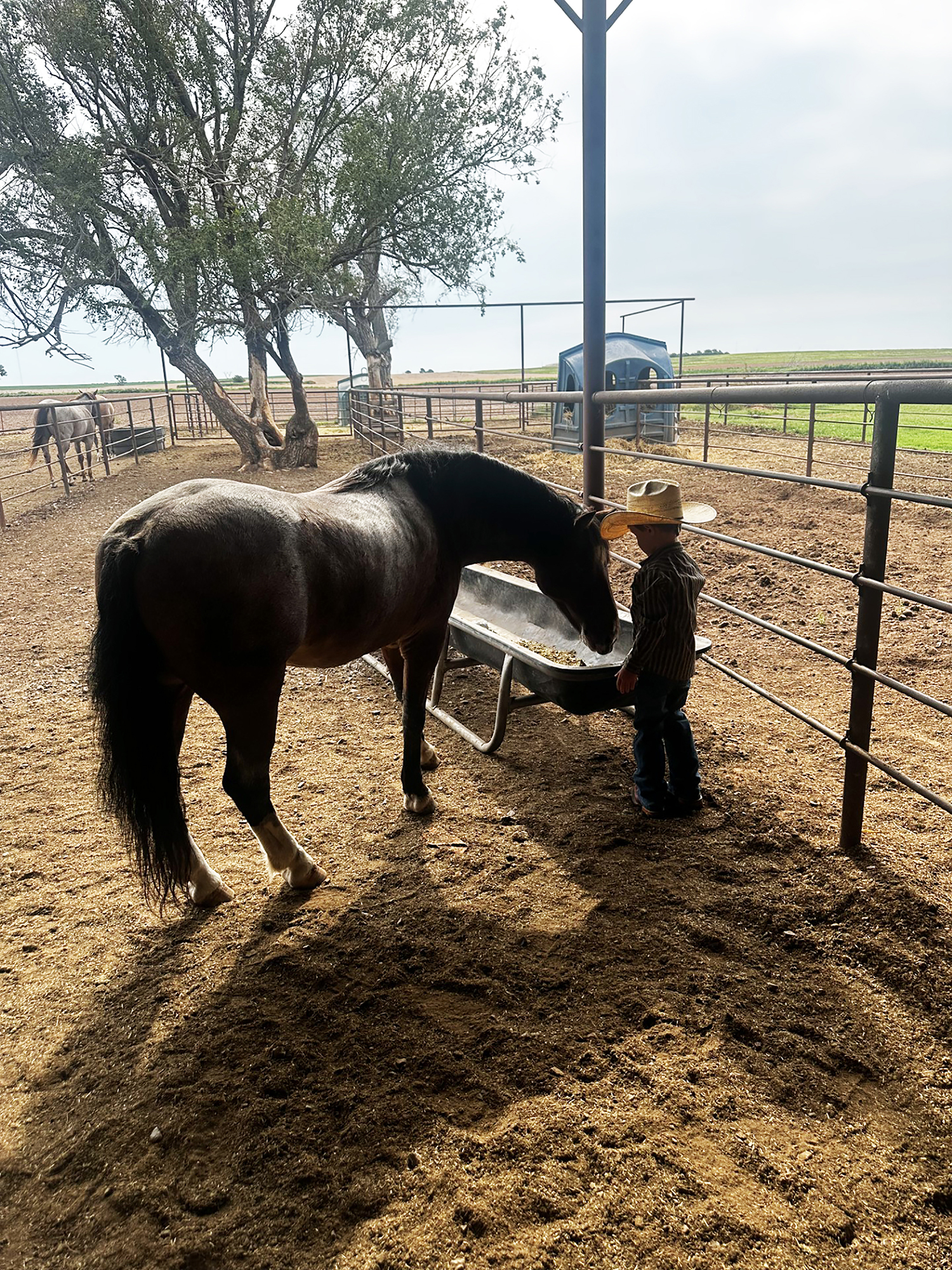
While the ponies in our life may love their time off in the winter you can’t convince me that they don’t love their jobs in the spring. Even if it’s just a little bit. When that little cowboy shoves a bucket of grain in their face after a job well done together, the ponies head sits a little higher and so does that little cowboys hat.


-
 Country Lifestyle2 years ago
July 2017 Profile: J.W. Hart
-
 Attractions9 years ago
48 Hours in Atoka Remembered
-
 Equine9 years ago
Umbilical Hernia
-
 Outdoors8 years ago
Grazing Oklahoma: Honey Locust
-
 Country Lifestyle4 years ago
The Two Sides of Colten Jesse
-
 Farm & Ranch8 years ago
Hackberry (Celtis spp.)
-
 Farm & Ranch1 year ago
From Plow to Plentiful: The Most Important Inventions in Agricultural History
-
 Equine5 years ago
On the Road with Emily Miller-Beisel